Hypoallergenic Flat Back Earrings: Titanium Studs Explained
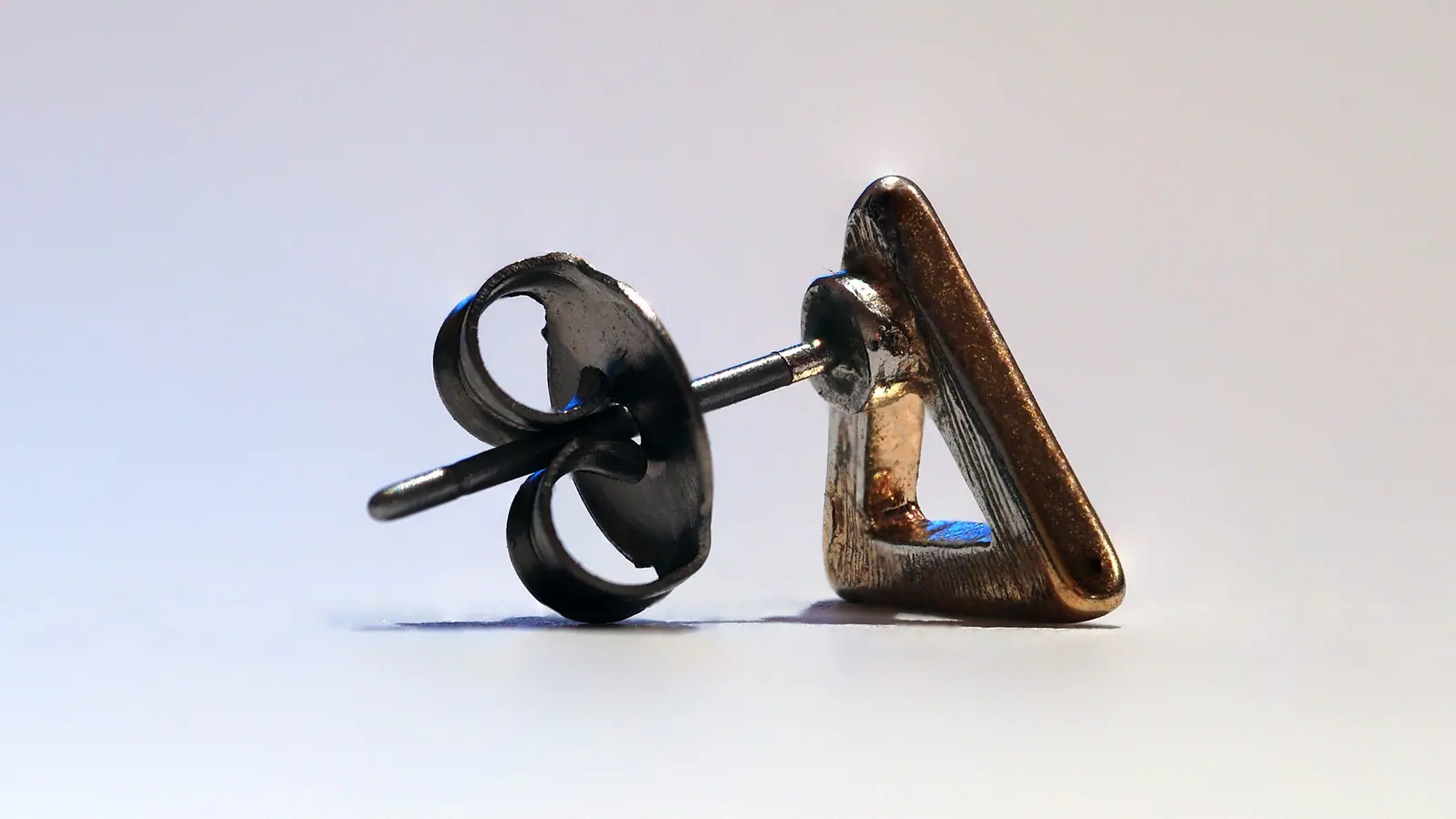

What are hypoallergenic flat back earrings? Hypoallergenic flat back earrings are studs with a flat disc on the back instead of a butterfly clutch, and a post made from a low-nickel metal such as implant-grade titanium. The disc sits flat against the skin, so there are no sharp ends to poke the back of the ear or the side of your head when you sleep. They’re popular for cartilage piercings and stacked lobes. The hypoallergenic part comes from the metal; the comfort part comes from the design.
Why the metal matters most
Piercing is the main route to nickel allergy. A meta-analysis by von Spreckelsen and colleagues found 5.9 times the odds of nickel allergy in pierced people. The EU’s REACH Annex XVII limits nickel release from any post inserted in a piercing to 0.2 µg/cm² per week. A flat back made from implant-grade titanium, niobium or solid gold avoids the problem; see our guides to titanium earrings and titanium vs surgical steel.
Does a flat back help?
There’s no study comparing flat-back studs with butterfly backs in ears, so the case for them is practical rather than proven:
- Embedded backs. A Cincinnati emergency department, reported by Timm and Iyer, saw 100 children with embedded earrings over five years; in 68 it was the back that sank into the skin, and 35% had infection. A smooth flat disc with the right post length may reduce that risk, but it hasn’t been tested.
- Flat discs elsewhere. The closest study is of labret (flat-back) studs in lips: Leichter and Monteith found gum recession behind the disc in 68% of pierced people versus 22% of controls. That’s a reminder that a flat disc still presses on tissue, so the post length must fit.
Cartilage piercing infections
Flat backs are often used in the upper ear, where infections are more serious:
- An Oregon outbreak investigated by Keene and colleagues found upper-ear cartilage piercings had 3.6 times the risk of suspected infection compared with lobes, traced to contaminated disinfectant and spring-loaded guns.
- Pooling 66 cases, Sosin and colleagues found Pseudomonas aeruginosa caused 87.2% of cartilage piercing infections and most patients were hospitalized.
- In 217 patients with ear cartilage infection, Ungar and colleagues found 55.3% were caused by piercing, with more abscesses than other causes.
- In England, Brown and colleagues traced 10 Pseudomonas cases to one studio’s handwash sink and water heater.
How to choose hypoallergenic flat back earrings
- Implant-grade titanium (ASTM F136) or solid niobium post and disc.
- Threadless or internally threaded posts, which are smooth when inserted.
- Right post length, with room for swelling in a new piercing; downsize once healed.
- Needle piercing by a professional, not a gun, especially for cartilage.
- See a doctor quickly if a cartilage piercing becomes red, hot and painful. Read more about hypoallergenic earrings and nickel allergy symptoms.
More in Jewelry
Hypoallergenic Earrings: Metals That Avoid Nickel
Hypoallergenic earrings for sensitive ears: which metals avoid nickel, how to read the label, and what to ask a seller before you buy a pair.
Titanium vs Surgical Steel: Which Suits Sensitive Skin?
Titanium vs surgical steel for nickel allergy: grades, nickel content, ASTM implant specifications, cost, and when each metal makes sense for your skin.
Is Sterling Silver Hypoallergenic? What Nickel Allergy Means
Is sterling silver hypoallergenic? Usually low in nickel, but plating, cheap alloys and tarnish complicate it. When silver suits sensitive skin.
Is 14k Gold Hypoallergenic? Karats, Alloys and Nickel
Is 14k gold hypoallergenic? Pure gold rarely causes reactions, but its alloy metals can. How karat, white or rose color and plating change nickel risk.
Sources & further reading
- JAMA — Keene and colleagues, 2004: an Oregon public health investigation of 186 piercings in 118 people at one kiosk found 7 confirmed Pseudomonas infections and 18 suspected infections; four patients were hospitalized. DOI: 10.1001/jama.291.8.981.
- The Laryngoscope — Sosin and colleagues, 2015: pooling 29 articles (66 patients) with infections after cartilage piercing, Pseudomonas aeruginosa caused 87.2% of infections and 92.3% of those patients were hospitalized. DOI: 10.1002/lary.25238.
- The Laryngoscope — Ungar and colleagues, 2025: of 217 patients treated for auricular perichondritis in 2006-2021, 120 (55.3%) had piercing-induced infection. DOI: 10.1002/lary.32409.
- Epidemiology and Infection — Brown and colleagues, 2025: the UK Health Security Agency traced 10 cases of Pseudomonas ear-cartilage infection to one piercing studio in 2023; bacteria from patients matched those in the studio's handwash sink, tap water and water heater. DOI: 10.1017/S0950268824001572.
- Pediatric Emergency Care — Timm and Iyer, 2008: A Cincinnati pediatric emergency department saw 100 children with embedded earrings in 2000-2005 (25 per 100,000 visits; median age 8). DOI: 10.1097/pec.0b013e31815f6f59.
- Dental Traumatology — Leichter and Monteith, 2006: this is the closest study of flat-back (labret) studs, but it concerns lip piercings, not ears. DOI: 10.1111/j.1600-9657.2006.00332.x.
- Contact Dermatitis — von Spreckelsen and colleagues, 2025: piercing was linked to nickel allergy in the general population (odds ratio 5.9) and in dermatitis patients (odds ratio 3.6), and 24.7% of European earrings intended for piercing exceeded EU nickel limits on the reference test. DOI: 10.1111/cod.14837.
- European Union (EUR-Lex) — Under REACH Annex XVII, any post assembly inserted into a pierced ear or other pierced body part, which includes flat-back labret posts, must release less than 0.2 µg/cm2/week of nickel.