Food Allergy Test: Skin Prick, Blood Test, Food Challenge
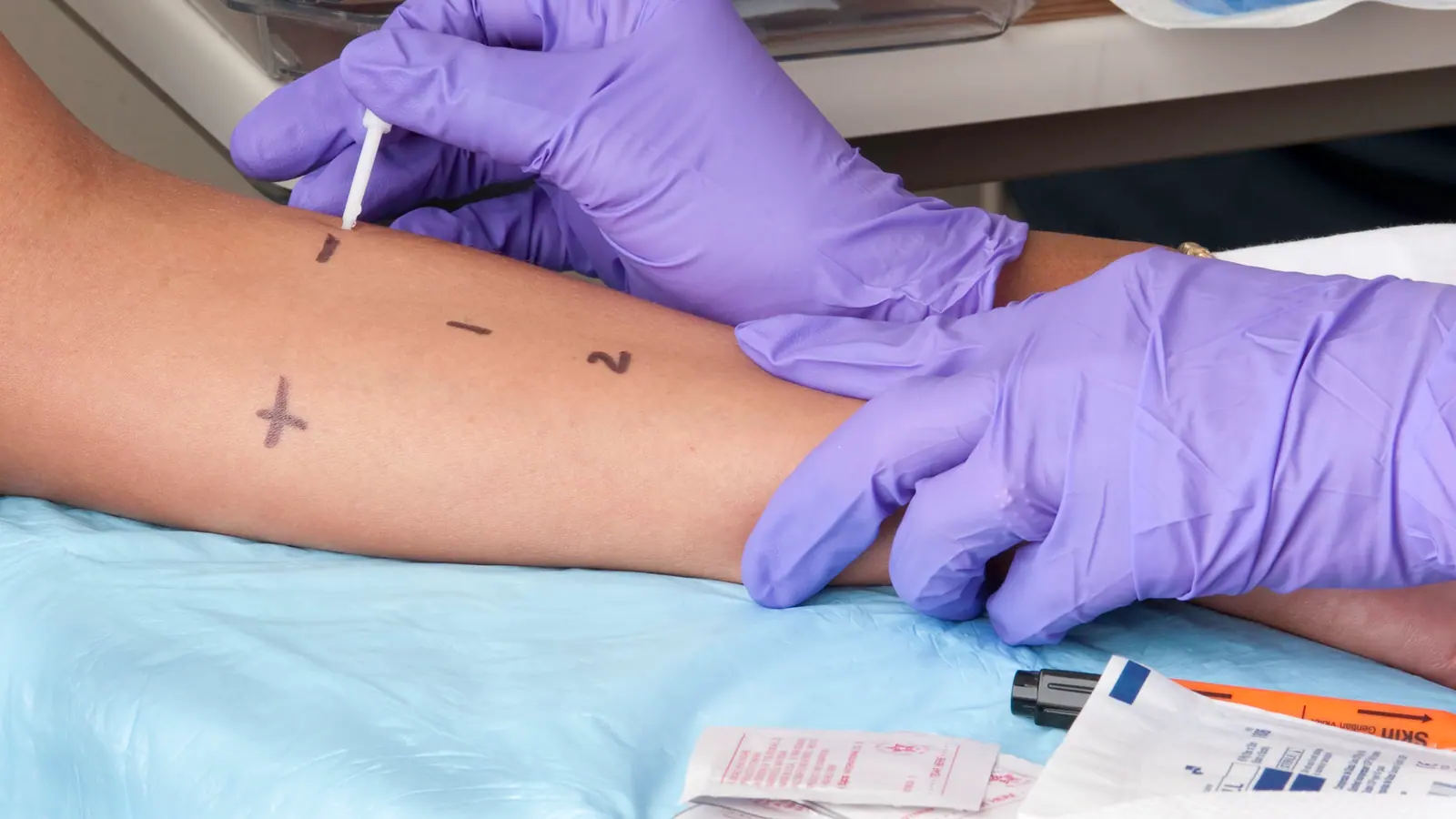

What is a food allergy test? A food allergy test checks whether your immune system makes IgE antibodies to a food, either with a skin prick test or a blood test. A positive result shows sensitization, not necessarily allergy, so allergists interpret it alongside your history of reactions. When the answer is still unclear, an oral food challenge in the clinic settles it.
Why the history comes first
The NIAID food allergy guidelines say reported food allergies must be confirmed, because studies show 50% to 90% of presumed food allergies turn out not to be allergies. The gap shows up in national data too: in a survey of 40,443 U.S. adults, Gupta and colleagues found 19% believed they had a food allergy, but 10.8% had symptoms that fit one.
So the allergist starts with questions: which food, how much, how soon symptoms began, what they were, and whether it has happened more than once. That narrows the testing to a few foods. Testing dozens of foods “just in case” produces positives that mean little and can lead to cutting out foods for no reason.
Skin prick test
A drop of food extract goes on the forearm or back, and the skin is pricked lightly through it. If you’re sensitized, a small itchy bump (a wheal) appears within about 15 minutes. It’s quick, cheap and done in the office.
The guidelines recommend it to help identify suspect foods, but stress that a skin prick test alone can’t diagnose food allergy. Bigger wheals make allergy more likely; small ones are often false alarms. You’ll usually need to stop antihistamines for several days beforehand.
Blood test (food-specific IgE)
A blood sample is checked for IgE against particular foods. It’s useful when skin testing isn’t possible, for example with widespread eczema or when antihistamines can’t be stopped. As with skin tests, the guidelines say these results alone aren’t diagnostic. Higher levels make allergy more likely, but there’s no single cut-off that fits every food and every person.
Some labs also test individual proteins within a food, called component testing. Your allergist decides when it adds anything.
Oral food challenge
The challenge is the most reliable test. Under medical supervision, you eat the food in gradually larger amounts while staff watch for a reaction, with emergency treatment on hand. The guidelines call the double-blind placebo-controlled challenge the gold standard, though an open challenge is often enough in practice.
An AAAAI work group describes how challenges are done safely in infants, children and adults, including challenges to baked milk and baked egg. A challenge can confirm an allergy, but often its best use is proving that a food is safe after years of needless avoidance.
Tests to skip
The NIAID panel recommends against a list of nonstandardized tests for diagnosing IgE-mediated food allergy, including:
- Food-specific IgG or IgG4 blood panels
- Hair analysis
- Applied kinesiology (muscle-strength testing)
- Electrodermal (Vega) testing
- Cytotoxicity assays
- Provocation-neutralization
IgG panels are the ones most often sold directly to consumers. A European task force report by Stapel and colleagues explained that IgG4 to foods simply shows you’ve eaten them, and may even reflect tolerance, so these tests shouldn’t be used for allergy or intolerance.
Testing before introducing peanut
For babies with severe eczema or egg allergy, the NIAID addendum guidelines suggest a doctor’s evaluation, which may include testing, before peanut foods are introduced. Most other babies don’t need testing first. Our guide to peanut allergy has the details.
After the test
If an allergy is confirmed, you’ll get a plan: which foods to avoid, how to read labels for the nine major allergens, and whether to carry epinephrine. Children are usually retested every so often, because milk, egg, wheat and soy allergies are often outgrown. Our main guide to food allergies covers symptoms and labels, and our guide to anaphylaxis symptoms explains when to use epinephrine.
See also our guide to food sensitivity test kits.
More in Food allergies
Food Allergies: The 9 Major Allergens, Symptoms and Labels
Food allergies, from the nine major U.S. allergens to symptoms and anaphylaxis, which tests work, how to read labels, and what's new from the FDA.
Tree Nut Allergy: Which Nuts Count, Symptoms and Labels
Tree nut allergy: the 12 nuts the FDA counts, why coconut is now off the list, cross-reactions, symptoms, testing and reading U.S. food labels.

Anaphylaxis Symptoms: Signs, What to Do and Epinephrine
Anaphylaxis symptoms to act on: the warning signs doctors use, why epinephrine comes first, the nasal spray option, and what to do after a reaction.

Shellfish Allergy: Symptoms, Labels and the Iodine Myth
Shellfish allergy: crustaceans vs mollusks, symptoms, why it's so common in adults, what U.S. labels must show, and why iodine isn't the cause.
Sources & further reading
- Journal of Allergy and Clinical Immunology — Boyce and colleagues, 2010: NIAID expert panel guidelines: skin and blood IgE tests alone aren't diagnostic, oral food challenges are the standard, and a list of nonstandardized tests not to use. DOI: 10.1016/j.jaci.2010.10.008.
- Allergy — Stapel and colleagues, 2008: EAACI task force report concluding that food-specific IgG4 reflects normal exposure, not allergy, and that IgG4 testing shouldn't be performed. DOI: 10.1111/j.1398-9995.2008.01705.x.
- Journal of Allergy and Clinical Immunology: In Practice — Bird and colleagues, 2020: AAAAI work group update on how to conduct and interpret oral food challenges safely in infants, children and adults. DOI: 10.1016/j.jaip.2019.09.029.
- JAMA Network Open — Gupta and colleagues, 2019: survey of 40,443 U.S. adults: 19% believed they had a food allergy, but 10.8% had convincing symptoms. DOI: 10.1001/jamanetworkopen.2018.5630.
- Journal of Allergy and Clinical Immunology — Togias and colleagues, 2017: NIAID addendum guidelines on when to test infants before introducing peanut foods. DOI: 10.1016/j.jaci.2016.10.010.
- U.S. Food and Drug Administration — Food allergies: the nine major food allergens and how they're labeled.