Silicone Teether: What's Safe, What to Skip and Why
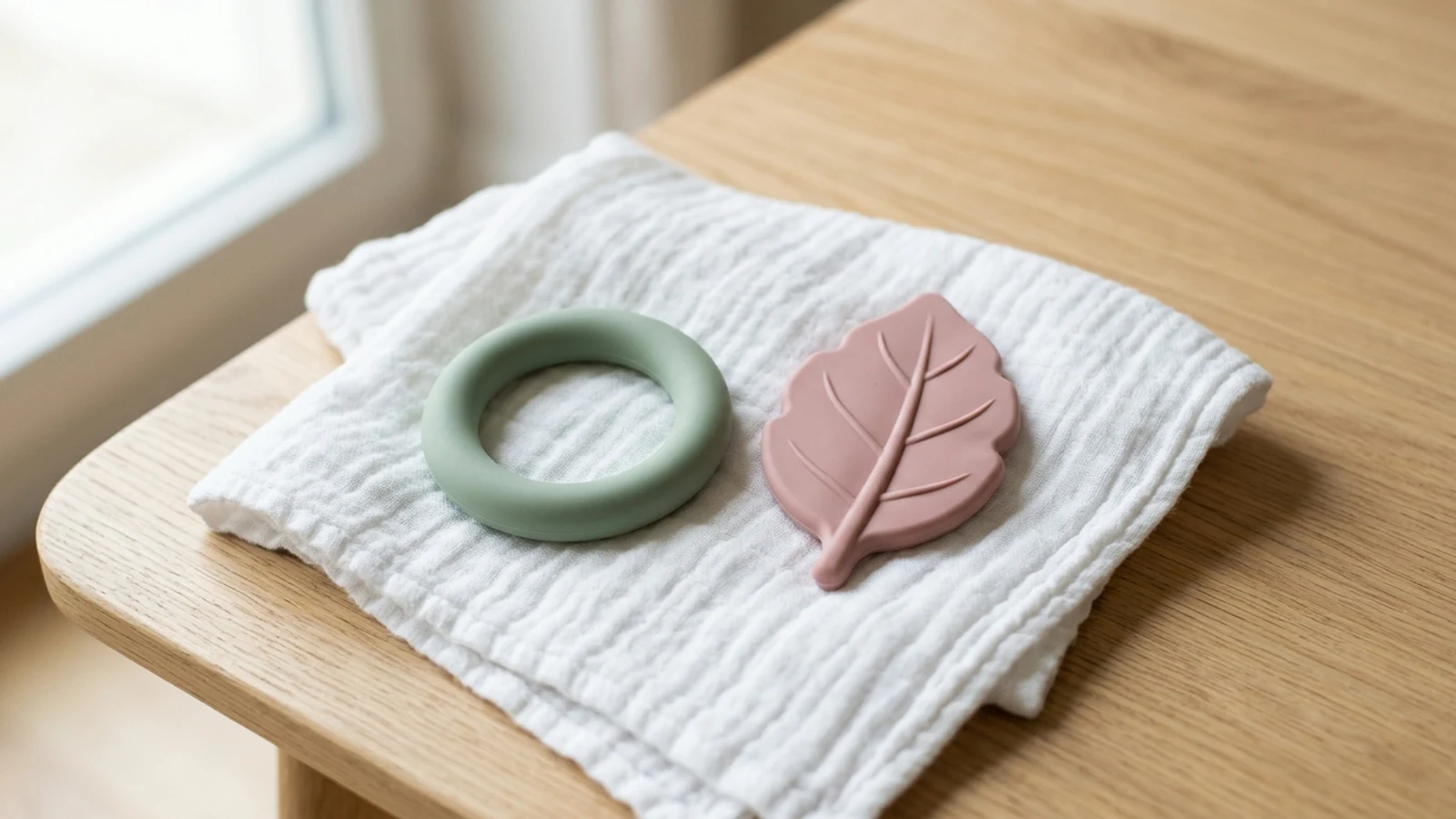
Is a silicone teether safe for babies? A solid silicone teether is one of the options health agencies point to for sore gums: the FDA suggests rubbing the gums or a firm teether that isn’t liquid-filled or frozen. Silicone isn’t completely inert, but no harm to babies from silicone teethers has been shown. The real dangers in teething are elsewhere: necklaces, numbing gels and homeopathic tablets.
Silicone teething: when it starts and what to expect
Teething usually starts around 6 to 8 months, according to MedlinePlus, and most children have all their baby teeth by age 2 to 3, the NHS says. Signs to expect:
- Common: pooling 16 studies of 3,506 children, Massignan and colleagues found 70.5% had some sign during tooth eruption, most often gum irritation (86.8%), irritability (68.2%) and drooling (55.7%).
- Short-lived: in 125 babies followed daily, Macknin and colleagues found biting, drooling, gum-rubbing and fussiness clustered in about 8 days around each new tooth, and no single symptom showed up in more than 35% of teething babies.
- Not caused by teething: a real fever or diarrhea. MedlinePlus says teething doesn’t cause them, and the NHS describes only a slightly raised temperature under 38°C (100.4°F). A baby with fever needs to be checked for other causes.
Silicone teething rings and teether rings: solid, not liquid-filled
Pick a solid teether ring. MedlinePlus warns against liquid-filled rings and plastic items that might break, and the FDA’s advice also specifies a teether that isn’t liquid-filled.
Material matters too. When Asimakopoulos and colleagues tested 59 U.S. teethers, including solid plastic, gel-filled and water-filled ones and most labeled “BPA-free”, they found parabens, bisphenols, benzophenones, triclosan and triclocarban leaching from intact surfaces. “BPA-free” doesn’t mean free of other chemicals.
Phthalates are regulated: the CPSC rule bans more than 0.1% of any of eight phthalates in each plasticized part of a product meant to help a child with teething.
Are silicone teething toys safe?
They’re among the simpler choices, but silicone isn’t completely inert:
- In 32 silicone bottle nipples, Feng and colleagues identified 30 methylsiloxanes, and far more migrated into reconstituted formula than into artificial saliva.
- Of 57 silicone teats, pacifiers and teethers marketed with nanotechnology claims, Su and colleagues found nearly 89% contained silver and zinc nanoparticles, with teethers holding the most. Steam disinfection raised the amount of metal that could be released, though the estimated risk from each metal was low.
No study we found has shown harm to babies from silicone teething toys. A plain silicone teether, without “antibacterial” or “nano-silver” claims, avoids the extra additives found in those tests.
Freezer teether: chilled, not frozen
Cold helps sore gums, but frozen is too far. The FDA recommends a teether that isn’t frozen, and MedlinePlus advises against putting anything frozen on the gums and suggests a cool teething ring instead. If a product is sold as a freezer teether, a spell in the fridge is the safer choice.
Silicone teething necklace and teether necklace for mom
Teething jewelry is the clearest danger in this category:
- The FDA reports deaths and serious injuries, including strangulation and choking, from teething jewelry such as amber necklaces, and MedlinePlus warns against tying anything around a baby’s neck.
- Cox and colleagues published the case of a baby strangled, though not fatally, on the first use of an amber teething necklace.
- In tests by Soudek and McLaughlin, 8 of 10 amber teething necklaces didn’t break open at 1.6 pounds of force, the average force shown to block a young child’s airway.
- The claimed benefit doesn’t hold up: Nissen and colleagues found intact amber beads released no measurable succinic acid, the supposed pain reliever.
A teether necklace for mom, worn by the parent for the baby to chew on, wasn’t the subject of these studies. The same choking and strangulation risks apply if the baby is ever left with it, so never let a baby wear it or sleep with it.
Teething mitt, wood teether and other shapes
We found no studies on teething mitts, wood teethers or mesh fruit teethers. The agency advice still applies to any of them: firm, in one piece, not liquid-filled, not frozen, and nothing that can break into small parts.
Silicone teether safety checklist
- Solid, one piece, with no liquid or gel inside.
- Chilled in the fridge, never frozen.
- Plain silicone, without “antibacterial” or nanoparticle claims.
- Nothing tied around the neck, and no teething jewelry such as necklaces or bracelets, which the FDA warns about.
- No benzocaine or lidocaine gels, and no homeopathic teething tablets. The FDA says they offer little or no benefit and can cause serious harm; benzocaine can cause methemoglobinemia, a dangerous drop in the blood’s ability to carry oxygen.
- Replace it if it cracks or tears, since MedlinePlus warns against teething items that might break.
Related guides
Drooling can irritate the skin around the mouth and chin; see baby eczema cream and baby lotion for gentle skin care.
Sources & further reading
- U.S. Food and Drug Administration — 2024: benzocaine and lidocaine gels and homeopathic teething tablets offer little or no benefit and can cause serious harm; teething jewelry has caused deaths and serious injuries; FDA suggests rubbing the gums or a firm, not liquid-filled teether that isn't frozen.
- MedlinePlus (U.S. National Library of Medicine) — 2024: teething usually starts at 6 to 8 months and doesn't cause fever or diarrhea; use a cool, firm rubber teething ring and avoid liquid-filled rings, breakable plastic, anything around the neck and anything frozen.
- NHS (National Health Service, England) — 2026: possible teething signs include sore red gums, a temperature slightly raised but under 38°C, a flushed cheek, extra dribbling, gnawing and poor sleep; no evidence teething causes diarrhea.
- Pediatrics — Macknin and colleagues, 2000: in 125 infants and 475 tooth eruptions, biting, drooling, gum-rubbing, irritability and mild temperature rise clustered around each tooth, but no symptom occurred in more than 35% of teething infants. DOI: 10.1542/peds.105.4.747.
- Pediatrics — Massignan and colleagues, 2016: pooling 16 studies of 3,506 children, 70.5% had some sign during tooth eruption, most often gum irritation, irritability and drooling; temperature could rise slightly, but not to fever. DOI: 10.1542/peds.2015-3501.
- Environmental Science & Technology — Asimakopoulos and colleagues, 2016: 59 U.S. teethers, solid, gel-filled and water-filled and most labeled BPA-free, leached parabens, bisphenols, benzophenones, triclosan and triclocarban. DOI: 10.1021/acs.est.6b04128.
- Science of The Total Environment — Feng and colleagues, 2022: 30 methylsiloxanes found in 32 silicone bottle nipples, with migration into formula far higher than into artificial saliva, so silicone isn't entirely inert. DOI: 10.1016/j.scitotenv.2022.154449.
- Journal of Environmental Sciences — Su and colleagues, 2024: of 57 nano-enabled silicone teats, pacifiers and teethers, nearly 89% contained silver and zinc nanoparticles; steam disinfection raised the bioaccessible metals, though estimated risk was low. DOI: 10.1016/j.jes.2022.08.001.
- U.S. Consumer Product Safety Commission — 2025: 16 CFR 1307 bans children's toys and child care articles, including products that help with sucking or teething, containing more than 0.1% of any of eight phthalates.
- Paediatrics & Child Health — Soudek and McLaughlin, 2017: 8 of 10 amber teething necklaces didn't open at 1.6 pounds of force, the average force shown to block a young child's airway. DOI: 10.1093/pch/pxx158.
- CJEM — Cox and colleagues, 2016: first published case of an infant's non-fatal strangulation on the first use of an amber teething necklace. DOI: 10.1017/cem.2016.342.
- BMC Complementary and Alternative Medicine — Nissen and colleagues, 2019: intact amber beads released no measurable succinic acid in skin-like solutions, and succinic acid didn't reduce inflammatory signals, undercutting the pain-relief claim. DOI: 10.1186/s12906-019-2574-9.
More in Baby
Introducing Allergens to Baby: When, Which Foods and How
Introducing allergens to baby: what the LEAP, EAT and other trials show, when to start, which foods to offer one at a time, and when to talk to a doctor first.
Hypoallergenic Stuffed Animals: Keeping Plush Toys Mite-Free
Hypoallergenic stuffed animals: why plush toys collect dust mites, how to wash, freeze or dry them to kill mites and remove allergen, and what to look for.

Baby Laundry Detergent: Do You Need a Special One?
Do you need a baby laundry detergent? Babies don't need a special brand, but fragrance-free, dye-free washing helps their skin. Plus pod safety.
Baby Wipes and Skincare for Sensitive Skin: What to Use
Baby wipes, bath cleansers, moisturizers and diaper creams for dry or eczema-prone baby skin: what research says and which ingredients to avoid.
Hypoallergenic Formula: What the Label Terms Mean
Hypoallergenic formula labels decoded: extensively hydrolyzed, amino acid-based, partially hydrolyzed and gentle, and why switching is a doctor's call.

Hypoallergenic Crib Mattress and Bedding: Safe Sleep First
Hypoallergenic crib mattress and bedding: how to reduce dust and allergens in a crib within safe-sleep rules, and what you can wash, cover and change.