What Am I Allergic To? A Product Trigger Finder

What am I allergic to? Only an allergy test read by a doctor can tell you for sure. This finder narrows it down: pick where you react and what you suspect, and it lists the product triggers and guides worth reading before that appointment. It runs in your browser, stores nothing and doesn't diagnose.
Allergy quiz: find your likely product triggers
Answers stay in your browser: nothing is saved or sent. The finder suggests guides to read; it can't tell you what you're allergic to.
How to know what you are allergic to
There are two very different kinds of allergy, and each has its own test. Knowing which one fits your symptoms saves a lot of guessing.
- A rash where something touched your skin, appearing hours or a day or two later (earlobes, wrist under a watch, eyelids, hands), points to allergic contact dermatitis. The usual culprits are metals, fragrance, preservatives, rubber chemicals and hair dye. See our guide to contact dermatitis.
- Sneezing, itchy eyes, hives or wheezing within minutes of exposure point to an immediate (IgE) allergy: dust mites, pet dander, pollen, mold or a food.
Write down what you used or touched in the 48 hours before each flare, and take photos of the rash. A doctor uses that diary to choose which allergens to test, and you’ll get more out of the visit.
Types of allergy testing
Patch test for allergies
A patch test is the test for skin reactions to things that touch you. Small amounts of standard allergens are taped to your back for 48 hours, and the skin is read again at around 72 to 96 hours, according to MedlinePlus. Some reactions appear even later, which is why dermatologists follow a set reading schedule. A dermatologist can add your own products to the series. The patch test skincare guide explains how this differs from trying a new cream at home.
Allergy scratch test
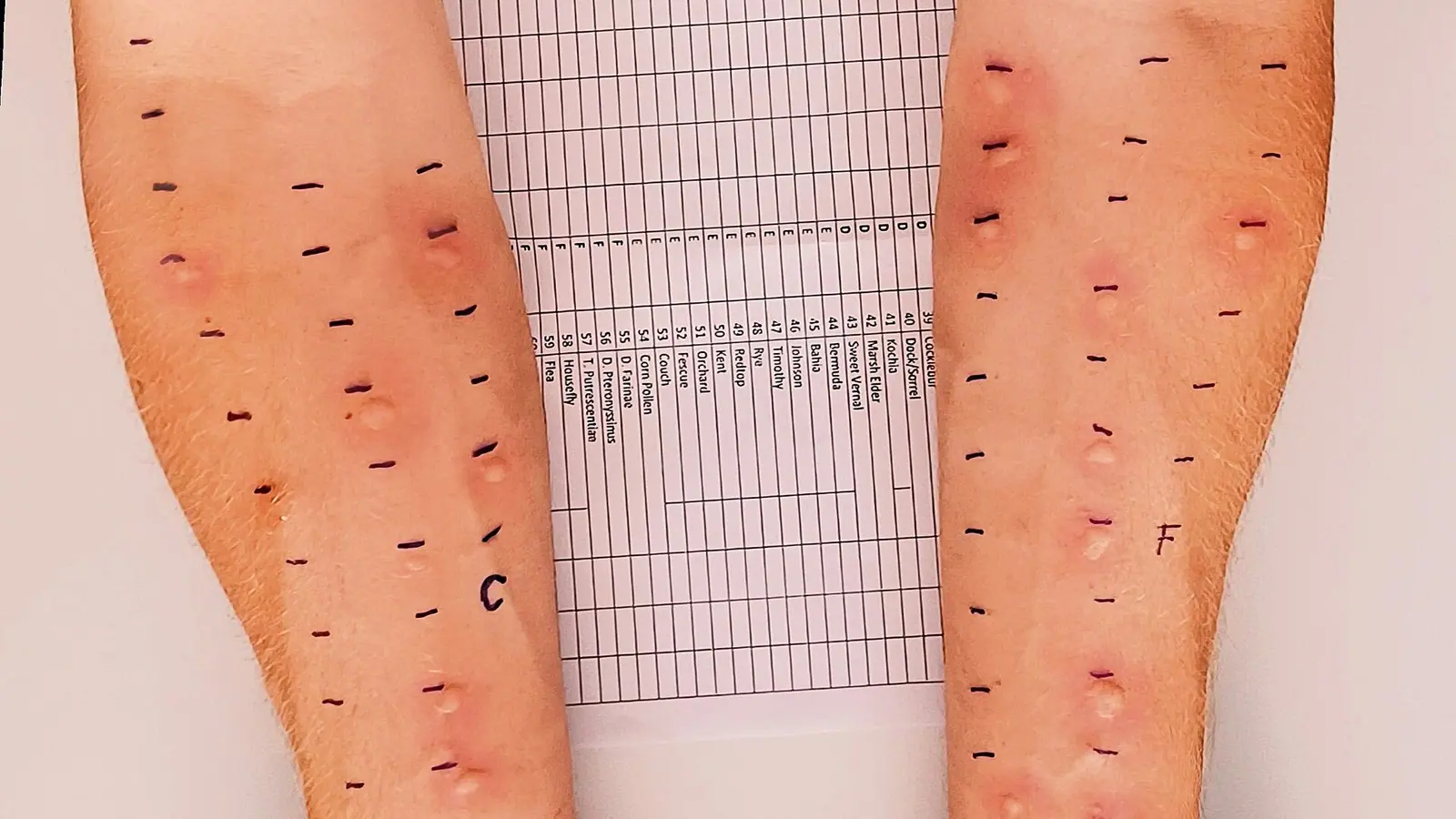
The scratch or skin prick test is for immediate allergies. A drop of each allergen is pricked into the skin of the forearm or back, and a raised, red wheal within 15 to 20 minutes suggests sensitization. It’s fast, but it doesn’t diagnose contact allergy to jewelry or cosmetics.
Blood test for skin allergy: what it can’t show
A blood test measures IgE antibodies, so it helps with the same immediate allergies as a prick test, for example when skin testing isn’t possible. It doesn’t detect the delayed reactions behind contact dermatitis. Like a prick test, a positive IgE result shows sensitization, not proof that the allergen causes your symptoms; US expert guidelines stress that these tests alone aren’t diagnostic of food allergy.
Common allergens list: skin and home
On the skin. In the latest North American patch test data (3,979 patients tested in 2023 and 2024), nickel was the top allergen at 26.4%, followed by the preservative methylisothiazolinone, cobalt and fragrance. Other common ones are formaldehyde releasers, rubber accelerators in gloves and PPD in hair dye.
| Allergen | Where you meet it | Start here |
|---|---|---|
| Nickel and cobalt | Earrings, belt buckles, jeans buttons, watch backs | Nickel allergy |
| Fragrance | Perfume, lotions, detergents, “unscented” products with masking scent | Fragrance allergy, hypoallergenic perfume |
| Preservatives | Wipes, shampoos, creams, paints | Methylisothiazolinone |
| Rubber and latex | Gloves, bandages, condoms, elastic | Latex allergy, non-latex condoms |
| PPD | Permanent and “black henna” hair dye | PPD allergy |
In the air at home. A national survey of 831 US homes found that more than half had at least six detectable indoor allergens: dust mites, pet dander, cockroach, mouse and mold. Our dust allergy guide explains each one, and the free room-by-room guide to reducing allergens at home shows how to cut them.
How to find out what you’re allergic to at home
You can narrow it down at home, but you can’t confirm it.
- Test the object, not yourself. A dimethylglyoxime (DMG) spot test turns pink when an earring or button releases nickel. It misses some low-release items; see the nickel allergy test guide.
- Use-test a new product. Dermatologists describe a repeated open application test: apply a product twice a day to the same small patch of the inner forearm for at least a week (dermatologists use 1 to 4 weeks) and watch for a rash. Stop at the first reaction. It only tells you about that product, and it’s not a substitute for patch testing.
- Skip IgG “sensitivity” kits. A European allergy task force concluded that IgG4 results reflect normal exposure to foods, not allergy. Our food sensitivity test guide covers why.
Call 911 for swelling of the lips, tongue or throat or trouble breathing. See a doctor promptly for a rash that spreads or blisters.
More in Ingredients & materials
Nickel Allergy: Causes, Sources, Rules and Testing
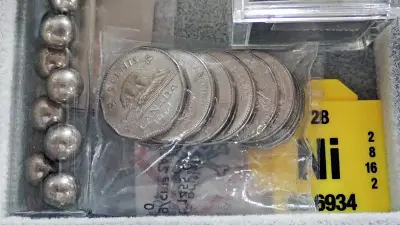
Nickel allergy: why nickel causes allergic contact dermatitis, where it's found, how US and EU rules differ, and how spot tests and patch tests work.

Fragrance Allergy: What 'Fragrance' and 'Parfum' Can Hide
Fragrance allergy: why one word on a label can stand for dozens of chemicals, which allergens dermatologists test for, and US vs EU label rules.

Methylisothiazolinone (MI): A Preservative Allergy Explained
Methylisothiazolinone (MI) and MCI/MI: where they're used, why allergy to them surged, how the EU restricted them, and how to spot them on labels.
Formaldehyde Allergy and Formaldehyde Releasers on Labels
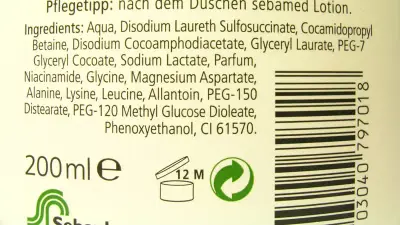
Formaldehyde allergy: which preservatives release formaldehyde, the label names to look for, where else it turns up, and what US and EU rules say.
Sources & further reading
- MedlinePlus (U.S. National Library of Medicine) — 2026: allergy testing of the skin: prick tests are read in 15 to 20 minutes; in patch testing, possible allergens are taped to the skin for 48 hours and checked again at 72 to 96 hours, which is how reactions to substances touching the skin are diagnosed.
- MedlinePlus (U.S. National Library of Medicine) — Contact dermatitis: the irritant and allergic types, common causes such as nickel, fragrances, preservatives, rubber and hair dye, and diagnosis with patch testing.
- Contact Dermatitis — Uter and colleagues, 2026: European Society of Contact Dermatitis guideline, updated in 2026, on how diagnostic patch testing should be performed and read. DOI: 10.1111/cod.70195.
- Dermatitis — Reeder and colleagues, 2026: north American Contact Dermatitis Group results for 3,979 patients tested in 2023 to 2024, with nickel (26.4%), methylisothiazolinone, cobalt and fragrance among the top allergens. DOI: 10.1177/17103568261486176.
- International Journal of Environmental Research and Public Health — Uter and colleagues, 2018: review noting that contact allergy affects about 27% of the general population in Europe and summarizing current problem allergens. DOI: 10.3390/ijerph15061108.
- Journal of Allergy and Clinical Immunology — Boyce and colleagues, 2010: NIAID expert panel guidelines: skin and blood IgE tests alone aren't diagnostic of food allergy, and a list of nonstandardized tests not to use. DOI: 10.1016/j.jaci.2010.10.008.
- Allergy — Stapel and colleagues, 2008: EAACI task force report concluding that food-specific IgG4 reflects normal exposure, not allergy, and that IgG4 testing shouldn't be performed. DOI: 10.1111/j.1398-9995.2008.01705.x.
- Postępy Dermatologii i Alergologii — Kaliyadan and colleagues, 2022: dermatologist consensus on standardizing the repeated open application test (a use test of a product on a marked area of skin). DOI: 10.5114/ada.2021.102850.
- Journal of Allergy and Clinical Immunology — Salo and colleagues, 2008: national survey of 831 US homes: more than half had at least six detectable indoor allergens, from dust mites, pets, cockroaches, mice and mold. DOI: 10.1016/j.jaci.2007.12.1164.
- MedlinePlus (U.S. National Library of Medicine) — Allergies: common allergens include pollen, dust, animal dander, mold, foods and medicines; symptoms and how allergies are diagnosed with skin or blood tests.