Allergy Action Plan: What It Includes and Where to Get One

What is an allergy action plan? An allergy action plan is a one-page, written set of instructions that tells anyone, from a teacher to a babysitter, exactly what to do if a person with a serious allergy has a reaction: which symptoms to look for, when to give epinephrine, what dose, and who to call. Your doctor fills it in and signs it. U.S. pediatric guidelines recommend one for everyone prescribed epinephrine (Pediatrics).
Emergency: If the plan says to give epinephrine, give it right away and call 911. Don’t wait for symptoms to get worse, and don’t give an antihistamine instead of epinephrine.
Food allergy action plan: what goes in it
A good plan fits on one page and can be read in seconds. The American Academy of Pediatrics report on completing these plans stresses that each one is personalized by the doctor (Pediatrics). The official forms leave space for:
- Who it’s for: name, date of birth, weight and a photo.
- The allergens: each food, sting or medicine that causes reactions.
- Risk factors: for example asthma, which experts list among the factors that can lower the threshold for giving epinephrine (Journal of Allergy and Clinical Immunology).
- Severe symptoms: the signs that mean “give epinephrine now”, such as trouble breathing, throat tightness, repeated vomiting, fainting, or symptoms in more than one body system.
- Mild symptoms: what to do for a few hives or an itchy mouth, and when to switch to epinephrine.
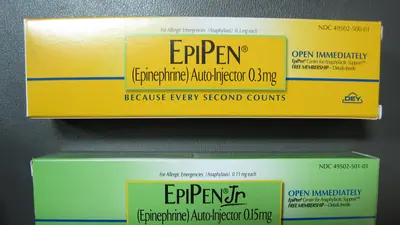
- Medicines and doses: the epinephrine device and strength (for example EpiPen 0.3 mg or 0.15 mg), and any other medicine.
- Emergency contacts: parents or guardians, the doctor, and 911.
- Signatures and date: the doctor’s and the parent’s.
The plan for an adult works the same way. Keep it with your epinephrine and share it with the people you spend time with.
FARE allergy action plan: the Emergency Care Plan
A widely used form is FARE’s Food Allergy & Anaphylaxis Emergency Care Plan, formerly called the Food Allergy Action Plan, which the CDC’s page on food allergies in schools links to. FARE (Food Allergy Research & Education) is a patient organization; the form is free on its website in English and Spanish, as a PDF you can type into and add a photo to. FARE asks you to fill in a short form before the download, which signs you up for its emails; you can unsubscribe.
Your allergist may prefer another official version, such as the American Academy of Pediatrics plan described in the clinical report above. Any of them works, as long as your doctor fills it in and signs it. Use the one your school or doctor asks for.
Printable allergy action plan PDF: how to fill it in
- Download the form your school or doctor uses and print two or three copies.
- Fill in the personal details and attach a recent photo.
- Bring it to your doctor, who marks the allergens, the symptoms that call for epinephrine, the doses and signs it. Don’t fill in the medical part yourself.
- Hand out copies to school, daycare, camp, coaches, grandparents and sitters, and keep one with each epinephrine kit.
- Review it at least once a year, before the school year, and whenever the weight, dose, device or allergies change. A child who crosses 30 kg (66 lb), for example, usually moves from the 0.15 mg to the 0.3 mg EpiPen (DailyMed).
Anaphylaxis action plan: when to give epinephrine
The heart of every plan is the line between “watch” and “give epinephrine now”. The U.S. practice parameter calls for prompt epinephrine as the first treatment for anaphylaxis (Annals of Allergy, Asthma & Immunology), and a 2026 international consensus of 34 experts set out, scenario by scenario, when to give epinephrine and when to call emergency services during reactions outside the hospital (Journal of Allergy and Clinical Immunology). Your doctor uses that kind of guidance to set your own thresholds; for example, some plans lower the threshold for people with asthma.
When the plan is unclear in the moment, the safer choice is to give epinephrine and call 911. Our EpiPen guide shows how to use it, and our anaphylaxis symptoms guide lists the warning signs. If you’re not sure which device fits, see our epinephrine auto-injector guide.
Peanut free classroom: the plan at school
CDC, with the Departments of Education, Agriculture and Justice, the FDA and NIH, published voluntary guidelines for managing food allergies in schools and early care programs. They ask each school to plan for daily management of each child’s allergy, emergencies, staff training, education of children and families, and a safe environment (CDC). The individual plan for a child is treated as an education record under federal privacy law.
What to ask your child’s school:
- Who keeps the plan and the epinephrine, and who is trained to use it, including on field trips and buses.
- Whether the school stocks its own epinephrine. All 50 states and DC allow schools to keep “stock” epinephrine for anyone who needs it, and 14 require it (Journal of School Health). It’s a backup, not a replacement for the child’s own two doses.
- How lunch, snacks and parties are handled.
Peanut-free rules are popular, but the evidence is mixed. In Massachusetts public schools, peanut-free schools and peanut-free classrooms didn’t change how often epinephrine was given, while schools with peanut-free tables had lower rates (Journal of Allergy and Clinical Immunology). The authors said more research is needed before setting policy, so a clear plan and trained staff matter more than a sign on the door. For the foods behind most reactions, see our food allergies guide and peanut allergy guide.
What we left out, and why
- A downloadable plan of our own.An emergency plan has to be filled in and signed by the patient's doctor. We point to the official forms instead of making a new one.
- Section 504 plans and other school legal rights.They depend on federal law, state law and each school district; ask the school and, if needed, the Department of Education's Office for Civil Rights.
What the evidence doesn’t settle yet
- Studies on which plan format works best in a real emergency are scarce.
- Evidence on peanut-free school policies comes mostly from one state and observational data.
More in Emergencies
EpiPen: How to Use It, Dosage, Expiration and Side Effects
EpiPen guide: how and when to use it, where to inject, EpiPen vs EpiPen Jr dosage, what to do with an expired pen, storage temperature and side effects.
Epinephrine Auto-Injector: EpiPen vs Auvi-Q, Generic, Neffy
Epinephrine auto-injector options compared: EpiPen vs Auvi-Q, generic auto-injectors and the neffy nasal spray, with doses by weight and what each one costs.

Traveling With Food Allergies: Flights, EpiPen, Chef Cards
Traveling with food allergies: how to get your EpiPen through TSA, lower the risk of a reaction on a plane, use allergy cards abroad and pick a safer hotel.
Sources & further reading
- Pediatrics — Wang and Sicherer, 2017: american Academy of Pediatrics clinical report: national guidelines recommend a written, personalized allergy and anaphylaxis emergency plan alongside an epinephrine prescription, with advice on how to fill one in. DOI: 10.1542/peds.2016-4005.
- Centers for Disease Control and Prevention — Food allergies in schools: about 1 in 13 children have food allergies; schools and early care programs should have plans to prevent reactions and respond to emergencies; links the Food Allergy & Anaphylaxis Emergency Care Plan.
- Centers for Disease Control and Prevention (CDC Stacks) — Hunt, 2013: voluntary Guidelines for Managing Food Allergies in Schools and Early Care and Education Programs, written with the Departments of Education, Agriculture and Justice, FDA and NIH under the FDA Food Safety Modernization Act.
- Annals of Allergy, Asthma & Immunology — Golden and colleagues, 2024: 2023 U.S. anaphylaxis practice parameter update: prompt epinephrine as first-line treatment and the role of emergency plans. DOI: 10.1016/j.anai.2023.09.015.
- Journal of Allergy and Clinical Immunology — Dribin and colleagues, 2026: international consensus of 34 experts on when to give epinephrine and when to call emergency services during allergic reactions outside the hospital. DOI: 10.1016/j.jaci.2025.11.008.
- Journal of School Health — Volerman and colleagues, 2022: review of state laws: all 50 states and DC allow schools to keep undesignated (stock) epinephrine; 14 require it. DOI: 10.1111/josh.13119.
- Journal of Allergy and Clinical Immunology — Bartnikas and colleagues, 2017: massachusetts public schools 2006 to 2011: peanut-free schools and classrooms didn't change epinephrine use rates; schools with peanut-free tables had lower rates. DOI: 10.1016/j.jaci.2017.01.040.
- U.S. National Library of Medicine (DailyMed) — EpiPen and EpiPen Jr prescribing information: weight-based doses and the instruction to carry two auto-injectors.