EpiPen: How to Use It, Dosage, Expiration and Side Effects
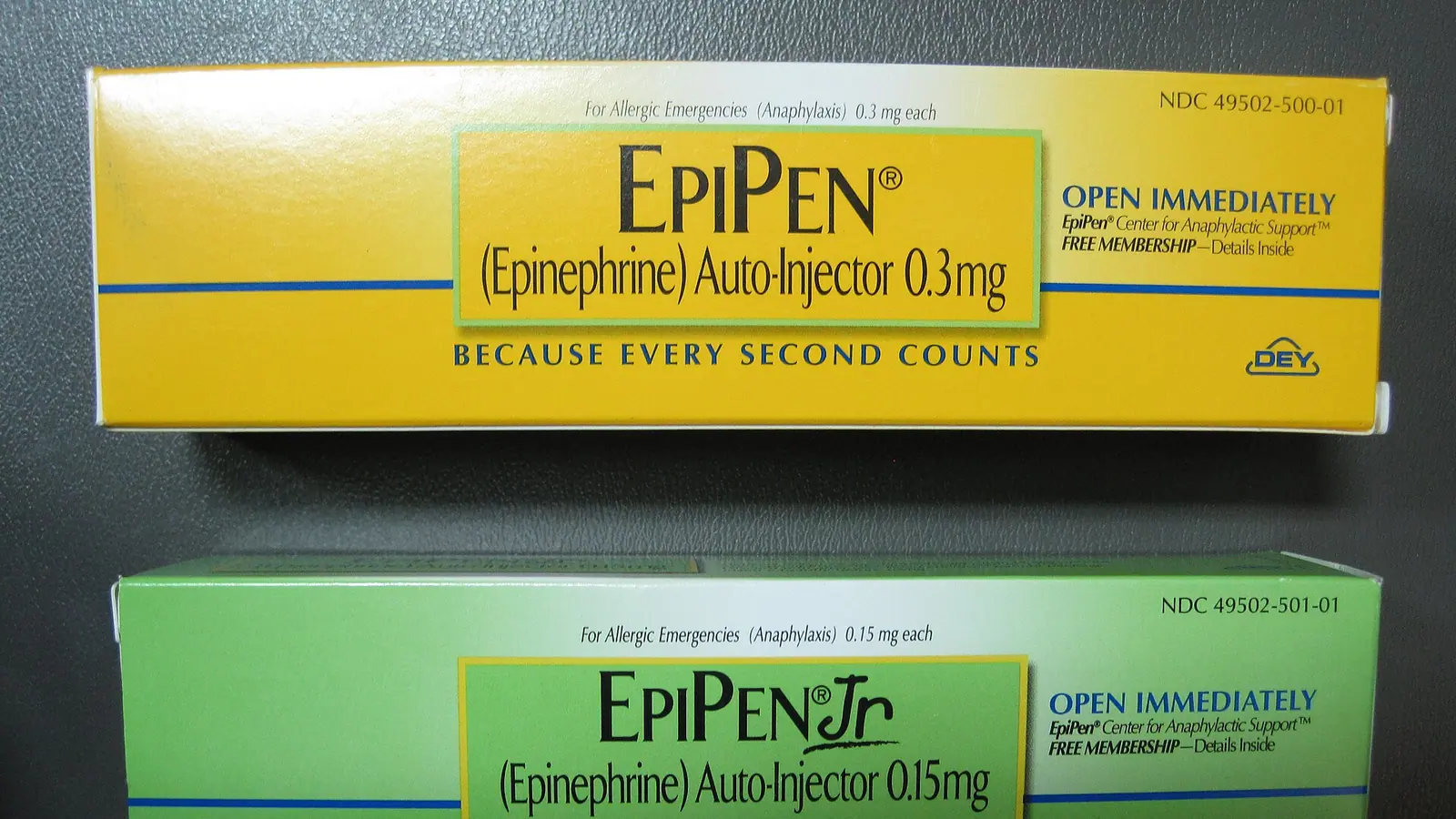

What is an EpiPen? An EpiPen is a pre-filled auto-injector that gives one dose of epinephrine (adrenaline) into the thigh to treat anaphylaxis, a severe allergic reaction. Use it as soon as a severe reaction starts, then call 911. It comes in two strengths, EpiPen 0.3 mg and EpiPen Jr 0.15 mg, chosen by body weight.
Emergency: If you think someone is having anaphylaxis (trouble breathing, throat tightness, swelling of the lips or tongue, fainting, or hives with vomiting), use their EpiPen right away and call 911. Don’t wait to see if it gets worse, and don’t give an antihistamine instead.
How to use an EpiPen
The steps below follow the FDA-approved EpiPen instructions on DailyMed. Other auto-injectors work differently, so if you carry another brand, read its own instructions.
- Slide the EpiPen out of its protective case. Hold it in one hand with the orange tip pointing down.
- Pull off the blue safety top straight up and away with your other hand. Don’t flip it off with your thumb, bend it or twist it, or the pen can fire by accident.
- Push the orange tip firmly against the middle of the outer thigh, at a right angle, through clothing if needed. You’ll hear a pop: that means it’s working.
- Keep pressing for 3 full seconds after the pop, counting slowly. If you pull it out too soon, you may not get the full dose.
- Lift it straight out. The orange tip extends to cover the needle. If you can still see the needle, don’t reuse it: use a new auto-injector. Throw away the blue safety top, which is a choking hazard for small children.
- Call 911, even if the person feels better.
Never put your thumb, fingers or hand over the orange tip. If you inject a finger, hand or foot by accident, go to the nearest emergency room and tell them where the injection went, because epinephrine can cut off blood flow there.
Most people get this wrong without practice. A review of 23 studies found that only 37% of patients and 32% of parents used an auto-injector correctly, and the most common mistake was not holding it long enough (Emergency Medicine Journal). Brief training made a big difference. Ask your pharmacist or allergist for a trainer pen and practice with it.
Where to inject an EpiPen
Inject only into the outer side of the thigh, halfway between the hip and the knee. The label says not to inject into the buttocks, a vein, or the fingers, hands or feet. For a child who might kick, hold the leg firmly before and during the injection: movement has caused cuts and bent or stuck needles.
When to use an EpiPen
Use it at the first signs of anaphylaxis, especially after contact with a known trigger such as a food, an insect sting or a medicine. The U.S. anaphylaxis practice parameters (2020 and 2023) name prompt epinephrine as the first treatment, and they link delays with worse outcomes.
Your allergist’s written emergency plan tells you exactly when to use it. If you’re unsure whether a reaction is “bad enough”, the safer choice is to use it: the risk of waiting is higher than the risk of the drug. Our anaphylaxis symptoms guide lists the warning signs body system by body system.
EpiPen dosage: EpiPen vs EpiPen Jr
| Device | Dose | Labeled for |
|---|---|---|
| EpiPen | 0.3 mg | People who weigh 30 kg (66 lb) or more |
| EpiPen Jr | 0.15 mg | Children who weigh 15 to 30 kg (33 to 66 lb) |
Each pen gives a single dose. The label says to carry two, because a second dose may be needed if symptoms don’t improve or come back, or if the first pen misfires. Children under 15 kg (33 lb) need a different product; their doctor will choose it. Our epinephrine auto-injector guide compares EpiPen with Auvi-Q, the generic versions and the nasal spray, including the 0.1 mg dose for small children.
EpiPen expiration: can you use an expired EpiPen?
Every EpiPen has an expiration date on the label, and the instructions say to replace the pack before that date. Check the viewing window too: the solution should be clear and colorless. If it looks pink, brown or cloudy, or has particles, replace it.
If an expired pen is the only one you have in an emergency, use it. A study of expired EpiPen and EpiPen Jr pens, 1 to 90 months past their date, found they held less epinephrine the older they were, but the authors concluded that a pen without discoloration or particles could still be used when nothing else is available, because some epinephrine is better than none (Journal of Allergy and Clinical Immunology). Then call 911.
Dispose of used or expired pens in an FDA-cleared sharps container, not in household trash.
How to store an EpiPen
- Keep it at room temperature, 20 to 25 °C (68 to 77 °F). Short trips between 15 and 30 °C (59 and 86 °F) are allowed by the label.
- Don’t refrigerate it, and keep it in its carrier tube, because epinephrine breaks down in light.
- Never leave it in a hot car. Pens stored at 70 °C (158 °F) for 10 days delivered only about 78% of their labeled dose (Drug Development and Industrial Pharmacy).
A systematic review found that ordinary day-to-day temperature swings didn’t measurably degrade epinephrine; damage came from prolonged heat (Annals of Allergy, Asthma & Immunology). Our anaphylaxis kit guide covers cases and carriers that keep both pens together and away from heat.
EpiPen side effects
According to the label, common side effects of epinephrine include anxiety, restlessness, shakiness, weakness, dizziness, sweating, a pounding heartbeat (palpitations), pale skin, nausea and vomiting, headache and breathing difficulty. They come from the drug’s normal action on the heart and blood vessels.
The label advises caution in people with heart disease, an overactive thyroid or diabetes, in older adults and in pregnant women, who can have stronger effects, and people with Parkinson’s may notice a brief worsening. None of these is a reason to skip epinephrine in a real emergency: the label calls it the first-line medication of choice for anaphylaxis, used the same way in people who are breastfeeding. Discuss your own risks with your doctor ahead of time.
What to do after using an EpiPen
- Call 911 or go to the emergency room, even if you feel better. Symptoms can come back hours later; this is called a biphasic reaction (Journal of Allergy and Clinical Immunology).
- Lie down with your legs raised, or sit up if breathing is hard. Don’t stand up or walk suddenly (Annals of Allergy, Asthma & Immunology).
- Use the second pen if symptoms don’t improve or return, as your plan directs.
- Give the used pen to the paramedics or put it in a sharps container.
- Get a replacement right away, so you always carry two, and see your allergist to review what happened.
Generic EpiPen
The FDA approved a generic epinephrine auto-injector from Teva in August 2018, rated as therapeutically equivalent (AB) to EpiPen (Drugs@FDA). A pharmacist can usually swap it for EpiPen unless the prescription says otherwise. It works a little differently, so learn its own steps. Our epinephrine auto-injector guide covers the generics and other devices side by side.
If your reactions come from insect stings, see our bee sting allergy guide; for foods, our food allergies guide explains the main triggers and how to read labels.
What we left out, and why
- Prices and coupons.Prices change with pharmacy and insurance. Our epinephrine auto-injector guide compares EpiPen with its alternatives instead.
- Using a pen that is discolored, cloudy or has particles.The FDA-approved label says to replace it; don't rely on it.
What the evidence doesn’t settle yet
- How much of the dose an expired pen still delivers depends on how old it is and how it was stored; no study gives a safe cutoff.
- Whether freezing harms an auto-injector hasn't been studied enough to say.
More in Emergencies
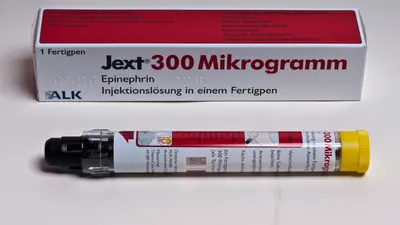
Epinephrine Auto-Injector: EpiPen vs Auvi-Q, Generic, Neffy
Epinephrine auto-injector options compared: EpiPen vs Auvi-Q, generic auto-injectors and the neffy nasal spray, with doses by weight and what each one costs.

Allergy Action Plan: What It Includes and Where to Get One
An allergy action plan tells anyone what to do in a reaction: what goes in it, which official form to use, who signs it, and how schools use it.

Traveling With Food Allergies: Flights, EpiPen, Chef Cards
Traveling with food allergies: how to get your EpiPen through TSA, lower the risk of a reaction on a plane, use allergy cards abroad and pick a safer hotel.
Sources & further reading
- U.S. National Library of Medicine (DailyMed) — FDA-approved EpiPen and EpiPen Jr prescribing information and patient instructions: weight-based doses, injection into the outer thigh, 3-second hold, carry two, storage at 20 to 25 °C, discard discolored solution, side effects and sharps disposal.
- Annals of Allergy, Asthma & Immunology — Golden and colleagues, 2024: 2023 U.S. anaphylaxis practice parameter update: prompt epinephrine as first-line treatment, revised diagnostic criteria and epinephrine auto-injector use. DOI: 10.1016/j.anai.2023.09.015.
- Journal of Allergy and Clinical Immunology — Shaker and colleagues, 2020: 2020 anaphylaxis practice parameter: epinephrine as first-line treatment and the risk of biphasic reactions after the first symptoms settle. DOI: 10.1016/j.jaci.2020.01.017.
- Journal of Allergy and Clinical Immunology — Simons and colleagues, 2000: expired EpiPen and EpiPen Jr auto-injectors 1 to 90 months past their date held less epinephrine the older they were; an expired pen without discoloration could still be used if it is the only one available. DOI: 10.1067/mai.2000.106042.
- Annals of Allergy, Asthma & Immunology — Parish and colleagues, 2016: systematic review of 9 studies: epinephrine degraded only with prolonged heat, short real-world temperature swings caused no significant loss, and evidence on freezing auto-injectors is limited. DOI: 10.1016/j.anai.2016.04.006.
- Drug Development and Industrial Pharmacy — Rachid and colleagues, 2016: auto-injectors kept at 70 °C for 10 days delivered about 78% of the labeled dose; pens exposed to excessive heat can't be relied on. DOI: 10.3109/03639045.2015.1035283.
- Emergency Medicine Journal — El Turki and colleagues, 2017: systematic review of 23 studies: only 37% of patients and 32% of parents used an auto-injector correctly; the most common error was not holding it in place long enough, and brief training helped. DOI: 10.1136/emermed-2016-205742.
- U.S. Food and Drug Administration (Drugs@FDA) — ANDA 090589: Teva's epinephrine auto-injector 0.3 mg and 0.15 mg, approved August 16, 2018, rated AB (therapeutically equivalent) to EpiPen.