Surgical Steel Earrings: Are They Safe for Nickel Allergy?
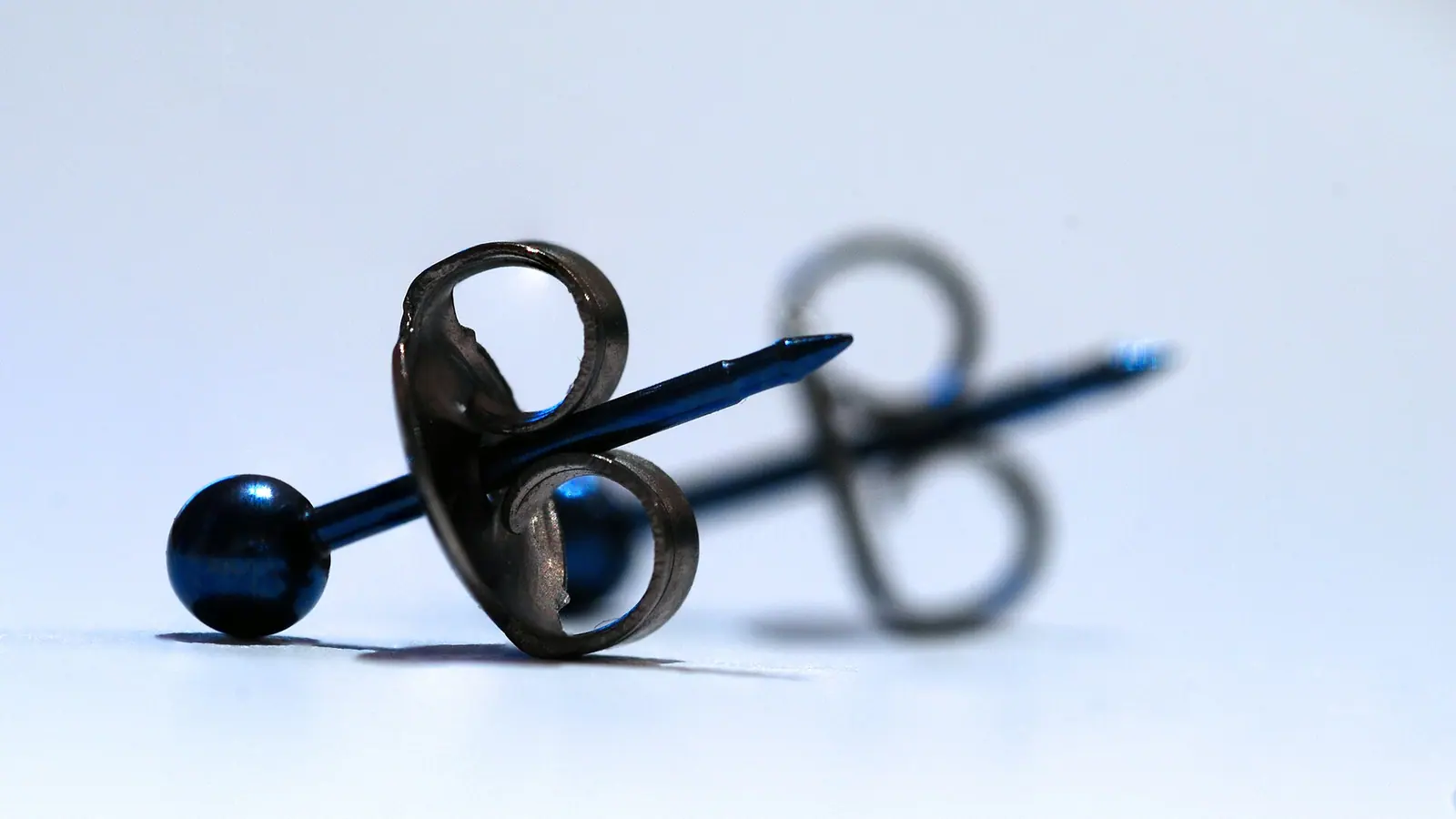

Are surgical steel earrings hypoallergenic? Often, but not always. Surgical steel earrings are stainless steel, which contains nickel, yet the best grades, such as low-sulfur 316L, hold that nickel so tightly that almost none reaches the skin. Problems come from other steel grades, from plating that damages the steel’s surface, and from cheap earrings labeled “surgical steel” that don’t meet the standard.
Does surgical steel have nickel?
Yes, usually: surgical steel is stainless steel, an alloy, and many grades include nickel. What matters for an allergy is how much nickel is released by sweat, not how much is in the metal. In a patch-test and sweat study, Haudrechy and colleagues compared steel grades directly:
| Material | Nickel released in artificial sweat | Nickel-allergic patients who reacted |
|---|---|---|
| Nickel plating | About 100 µg/cm²/week | 96% |
| 303 stainless steel (high sulfur) | About 1.5 µg/cm²/week | 14% |
| 304 and 316L stainless steel (low sulfur) | Under 0.03 µg/cm²/week | None |
Other studies agree. Lidén and colleagues found three unplated stainless steels caused no reactions in 100 nickel-allergic people, and Jensen and colleagues found four stainless steels released under 0.05 µg/cm²/week and caused no reactions in 31 nickel-allergic volunteers. That’s well under the EU limit of 0.2 µg/cm²/week for piercing posts set by REACH Annex XVII.
316L surgical steel: why the grade matters
A tag that just says “surgical steel” doesn’t tell you the grade. Kanerva and colleagues reported a nickel-allergic patient who developed dermatitis from stainless steel, a reminder that some grades release enough nickel to cause symptoms. Ask for the grade by number. Surgical steel earrings for sensitive ears should be a stated low-sulfur grade such as 316L, and solid, not plated.
Plating can spoil good steel. Gold-colored or black steel earrings are often plated, and that can change everything. Testing to the EN 1811 standard, Emanuele and colleagues found that electroplating made even 316L release nickel, because the process strips the steel’s protective passive layer and the plating itself is porous. Thicker precious-metal layers reduced the release, and PVD coatings that left the passive layer intact released no nickel. So a gold-tone “316L” earring isn’t automatically as safe as plain 316L.
Labels and test results don’t always match. Market checks keep finding failures. In Germany’s 2014 surveillance, Uter and Wolter found 26 of 160 piercing posts (16.2%) released too much nickel, no better than in 2008. A meta-analysis by von Spreckelsen and colleagues found 24.7% of European earrings meant for piercing exceeded EU limits, and by spot test 31.1% of North American earrings released nickel. Don’t rely on the at-home spot test to clear a pair: in Denmark, Wennervaldt and colleagues found it caught only 45.2% of earrings above the piercing limit.
Surgical steel vs titanium
For most people with a mild nickel allergy, solid 316L steel works well. If you’re highly sensitive, have reacted to steel before, or are healing a new piercing, a metal that isn’t a nickel alloy avoids the question; titanium allergy was found in only 0.6% of 1,500 implant patients by Sicilia and colleagues. Our side-by-side titanium vs surgical steel comparison and is stainless steel hypoallergenic go deeper, and titanium earrings covers the alternative.
How to buy surgical steel earrings
- Ask for the grade, ideally 316L, for the post and the back.
- Prefer plain, unplated steel if you react easily; if you want gold tone, ask whether it’s PVD or electroplated.
- Buy from sellers who state the grade in writing, not just “surgical steel.”
- Stop wearing a pair that makes your ears itch, even if the label says surgical steel.
Related guides
If your ears react to most metals, start with earrings for sensitive ears. Backs are often a different metal, so see hypoallergenic earring backs, and for new piercings read hypoallergenic piercing jewelry.
More in Jewelry
Hypoallergenic Earrings: Metals That Avoid Nickel
Hypoallergenic earrings explained: which metals avoid nickel, how to read the label, and what to ask a seller before you buy a pair for sensitive ears.
Titanium vs Surgical Steel: Which Suits Sensitive Skin?
Titanium vs surgical steel for nickel allergy: grades, nickel content, ASTM implant specifications, cost, and when each metal makes sense for your skin.
Is Sterling Silver Hypoallergenic? What Nickel Allergy Means
Is sterling silver hypoallergenic? Usually low in nickel, but plating, cheap alloys and tarnish complicate it. When silver suits sensitive skin.
Is 14k Gold Hypoallergenic? Karats, Alloys and Nickel
Is 14k gold hypoallergenic? Pure gold rarely causes reactions, but its alloy metals can. How karat, white or rose color and plating change nickel risk.
Sources & further reading
- Contact Dermatitis — Haudrechy and colleagues, 1994: 304 and 316L steels released under 0.03 µg/cm²/week of nickel and caused no reactions, while 303 steel released about 1.5 and caused reactions in 14% of nickel-allergic patients. DOI: 10.1111/j.1600-0536.1994.tb01997.x.
- British Journal of Dermatology — Lidén and colleagues, 1996: three non-plated stainless steels caused no reactions in 100 nickel-allergic people, while plated nickel underlayers did. DOI: 10.1111/j.1365-2133.1996.tb07601.x.
- Contact Dermatitis — Jensen and colleagues, 2003: four stainless steels released under 0.05 µg/cm²/week of nickel in sweat and none of 31 nickel-allergic volunteers reacted to them. DOI: 10.1034/j.1600-0536.2003.00118.x.
- Contact Dermatitis — Kanerva and colleagues, 1994: some metal samples released considerable nickel despite a negative spot test, and a nickel-allergic patient developed dermatitis from stainless steel. DOI: 10.1111/j.1600-0536.1994.tb02023.x.
- Heliyon — Emanuele and colleagues, 2024: electroplating made 316L steel release nickel by stripping its passive layer; PVD coatings that left the layer intact released none. DOI: 10.1016/j.heliyon.2024.e37125.
- Contact Dermatitis — Uter and Wolter, 2017: 16.2% of 160 piercing posts in German 2014 surveillance failed the nickel test, unchanged from 2008. DOI: 10.1111/cod.12941.
- Contact Dermatitis — von Spreckelsen and colleagues, 2025: 24.7% of European piercing earrings exceeded EU nickel limits; by spot test, 11.3% of European, 34.5% of Asian and 31.1% of North American earrings released nickel. DOI: 10.1111/cod.14837.
- Contact Dermatitis — Wennervaldt and colleagues, 2021: 14.8% of 304 Danish earrings broke EU nickel limits, and the spot test caught only 45.2% of those above the piercing limit. DOI: 10.1111/cod.13832.
- European Union (EUR-Lex) — 2026: REACH Annex XVII entry 27: piercing posts must release less than 0.2 µg/cm²/week of nickel and other earring parts no more than 0.5.
- Clinical Oral Implants Research — Sicilia and colleagues, 2008: only 9 of 1,500 dental implant patients (0.6%) tested positive for titanium allergy. DOI: 10.1111/j.1600-0501.2008.01544.x.