Angular Cheilitis: Causes, Treatment and How to Heal It
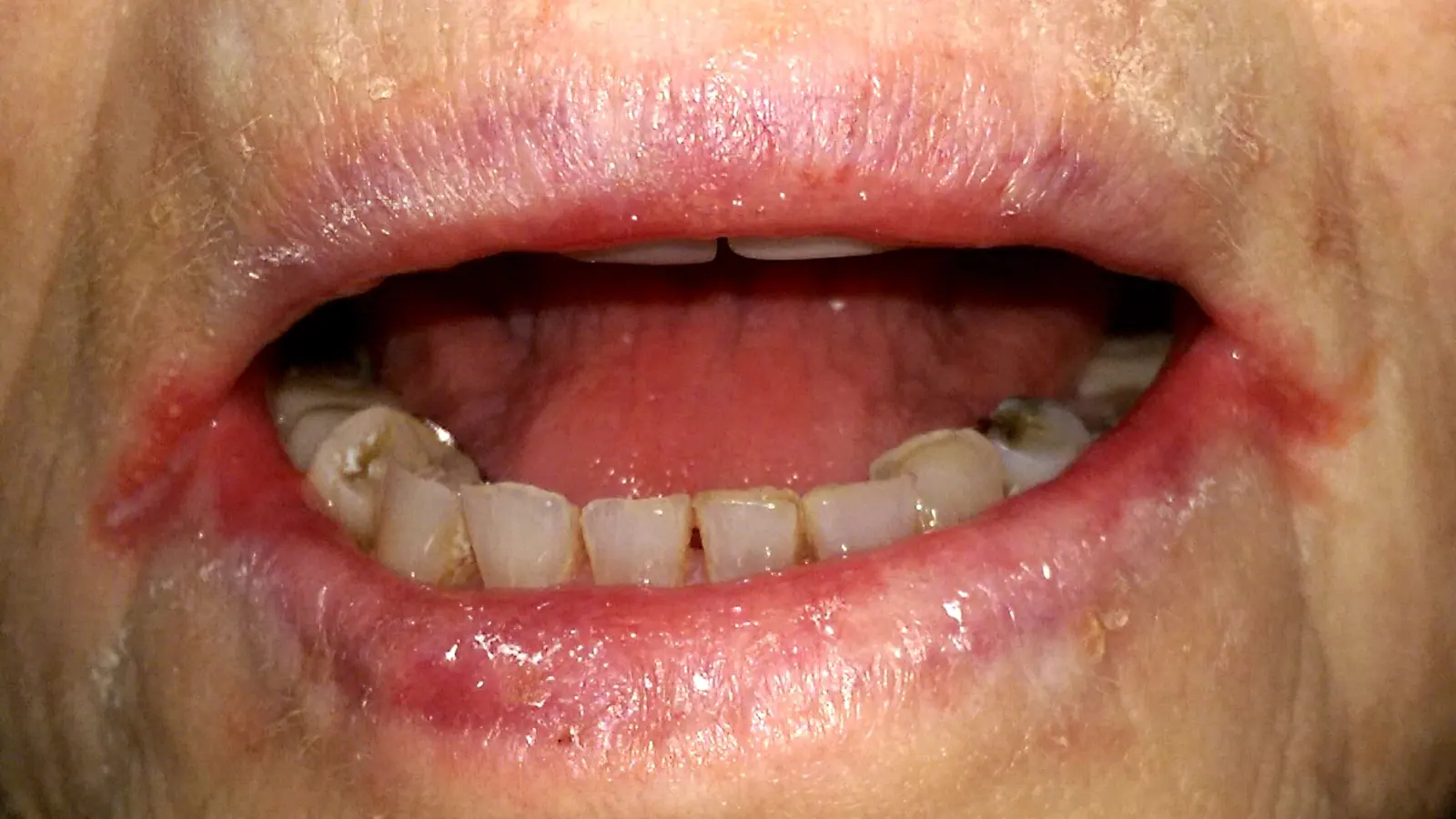

What is angular cheilitis? Angular cheilitis is inflammation at the corners of the mouth. The skin there turns red, cracks and stings, and it can crust or bleed when you open wide. It usually comes from saliva sitting in the folds, often with a yeast or bacterial infection on top, and it heals once the cause is treated, usually with an ointment and a few changes to keep the corners dry.
It’s common at both ends of life: a 2024 review describes one peak in childhood and another in adults, and it gets more frequent with age. Doctors also call it perleche.
Cracked lip corners
Cracked lip corners are the main sign. A treatment review in Oral Diseases describes redness, splits, small ulcers and crusting at one or both corners and the skin just around them. It’s usually sore and uncomfortable (Cabras). In people with dentures, the crack can run deeper along the fold at the corner (Öhman).
Cold sore corner of mouth
A cold sore and angular cheilitis can both show up at the corner of the mouth, but they’re different problems:
| Cold sore | Angular cheilitis | |
|---|---|---|
| Cause | Herpes simplex virus (MedlinePlus) | Moisture, yeast and bacteria in the fold |
| Looks like | A cluster of small blisters that crust | A red crack or split in the corner itself |
| Contagious | Yes | Not in the way cold sores are |
| Treatment | Heals in a few weeks; antivirals can speed it up | Antifungal or antibacterial ointment, keeping the corner dry |
If you aren’t sure which one you have, ask a pharmacist or doctor before buying a cream, since the treatments are different.
What causes angular cheilitis
Several things usually work together (Chiriac):
- Saliva in the corners. Deep folds at the corners, loose dentures, lip licking and drooling at night keep the skin wet. Lip licking is a common cause of dry, cracked lips that then split at the corners (Fonseca).
- Yeast and bacteria. In a study of 64 patients, Staphylococcus aureus grew from 40 lesions and Candida albicans from 45 (Öhman).
- Low iron. In a group of 49 adults, 18 had low hemoglobin, 8 of them with iron-deficiency-type anemia (Warnakulasuriya).
- Braces and oral hygiene. About 11% of 660 orthodontic patients had it, less often when they kept their teeth clean (Cross).
- Contact allergy. A flavoring in toothpaste can inflame the lips: in an Italian multicenter study, toothpaste allergy was confirmed in 15 of 54 patients with lip eczema; flavorings were the main culprits, and spearmint oil gave the most positive patch tests (Francalanci). Our hypoallergenic toothpaste guide covers the flavor allergens.
Angular cheilitis can also be a sign of another condition (Chiriac), so see a doctor if it keeps coming back.
Is angular cheilitis contagious?
Angular cheilitis isn’t caused by a virus that spreads by kissing, as cold sores are (MedlinePlus). The yeast and bacteria found in it (Öhman) take hold because the corner stays wet and cracked. Still, while it heals, don’t share lip balm, lipstick, towels or cups.
Angular cheilitis treatment
The aim is to clear any infection and stop the corners from staying wet:
- Treat the infection. In a study that matched the ointment to the germ found, nystatin (for yeast), fusidic acid (for staph) or both cleared signs of infection in 96% of 50 patients within 42 days (Öhman and Jontell). Fusidic acid isn’t sold in the U.S., so a doctor here would choose another antibacterial ointment.
- Protect the skin. A plain, bland lip balm keeps the corners from drying and cracking further (Fonseca).
- Fix the cause. Have dentures checked if they’re loose or worn, stop licking the lips, and ask about a blood test for iron if it keeps coming back (Warnakulasuriya).
Antifungal cream for angular cheilitis
Antifungal creams and ointments are the usual first treatment, but the evidence is thin: the Oral Diseases review found only two old randomized trials. In one of them, corners treated with nystatin healed within 28 days, while those given a placebo didn’t (Öhman and Jontell). Some clinicians use an ointment that combines an antifungal with a prescription steroid (Cabras). If staph is the problem, an antifungal alone may not be enough, which is why a doctor may take a swab.
Angular cheilitis treatment over the counter
Over the counter, the safest first step is a plain, bland balm to protect the corners. Over-the-counter antifungal creams aren’t labeled for use on the lips, so ask a pharmacist or doctor before putting one on the corners of your mouth. Avoid scented or flavored lip products on the cracks: fragrance and flavorings are common lip allergens, as our hypoallergenic lip balm guide explains. See a doctor if it doesn’t get better, keeps coming back or spreads.
Angular cheilitis lip balm
A good angular cheilitis lip balm is bland: no fragrance, no flavor, no menthol or cinnamon. A lip balm with UV protection is part of the prevention plan suggested for lip-licking dermatitis (Fonseca). Put it on the corners at night too, when saliva tends to collect.
Angular cheilitis overnight cure
There isn’t one. In the treatment study, lesions took weeks to heal, and older age, dry skin and deep skin folds at the corners slowed healing (Öhman and Jontell). What helps overnight is keeping the corners covered with a protective balm and not licking them.
Cheilitis lips
Cheilitis is the medical word for inflamed lips, and angular cheilitis is just one type (Chiriac). If your whole lip is dry, flaky or itchy, the cause is more often lip licking, weather or a contact allergy to a lip product; our lipstick allergy guide covers color cosmetics.
Actinic cheilitis
Actinic cheilitis is different and more serious: it’s lip damage from years of sun exposure, and it can turn into lip cancer: a systematic review put the rate at about 3% in the one study that measured it. People with years of sun exposure, older men, fair-skinned people and smokers are at higher risk. Any patch on the lip that doesn’t heal needs a doctor. Our hypoallergenic sunscreen guide covers gentle sun protection options.
More in Personal care
Hypoallergenic Sunscreen: Mineral vs Chemical Filters
Hypoallergenic sunscreen: why zinc oxide and titanium dioxide rarely cause allergy, which chemical filters react most, and how to read Drug Facts.
Hypoallergenic Hair Dye: PPD-Free Options and the Skin Test
Hypoallergenic hair dye and PPD-free claims: what causes hair dye allergy, how to do the skin test on the label, and when to see a doctor before you color.
Hypoallergenic Deodorant: How to Choose for Sensitive Skin
Hypoallergenic deodorant for sensitive underarms: why fragrance causes most reactions, deodorant vs antiperspirant, baking soda, and what to use instead.
Hypoallergenic Shampoo: Ingredients to Avoid and How to Pick
Hypoallergenic shampoo: what the label really means, common allergens such as fragrance and preservatives, signs of a reaction, and how to choose.
Sources & further reading
- Wiener Medizinische Wochenschrift — Chiriac and colleagues, 2024: review: angular cheilitis is a special type of cheilitis with mixed, mostly bacterial and fungal causes; it may signal an underlying disease; age peaks in childhood and adulthood and it becomes more frequent with aging. DOI: 10.1007/s10354-024-01037-9.
- Oral Diseases — Cabras and colleagues, 2020: narrative review of angular cheilitis treatment: redness, cracks, ulcers and crusting of the lip corners; antifungals are the usual first-line treatment but supported by only two old randomized trials; restoring bite height, B-vitamin supplements and other options studied only in small series; the authors use an antifungal plus prescription steroid ointment (isoconazole/diflucortolone). DOI: 10.1111/odi.13183.
- Journal of Oral Pathology — Öhman and colleagues, 1986: 64 patients with angular cheilitis: Staphylococcus aureus grown from 40 and Candida albicans from 45; denture wearers often had a deep lesion along the fold; atopic constitution and skin disease were common. DOI: 10.1111/j.1600-0714.1986.tb00610.x.
- Acta Odontologica Scandinavica — Öhman and Jontell, 1988: treatment based on microbial analysis with nystatin and/or fusidic acid ointment: 96% of 50 patients had no sign of infection after 42 days; in a double-blind comparison, nystatin-treated lesions healed by 28 days while placebo-treated lesions persisted; older age, dry skin and deep skin folds slowed healing. DOI: 10.3109/00016358809004776.
- Journal of Oral Pathology and Medicine — Warnakulasuriya and colleagues, 1991: 49 adults with angular cheilitis: 18 had low hemoglobin, 8 with iron-deficiency-type anemia; pathogens in 59% of lesions (Candida in 24, Staphylococcus aureus in 11); lesions lasted from 1 month to more than 4 years. DOI: 10.1111/j.1600-0714.1991.tb00915.x.
- Journal of Orthodontics — Cross and colleagues, 2010: 660 orthodontic patients: 11% had angular cheilitis; good oral hygiene was linked to lower prevalence. DOI: 10.1179/14653121042930.
- International Journal of Women's Dermatology — Fonseca and colleagues, 2020: lip licking worsens dry, cracked lips and can lead to irritant dermatitis, angular cheilitis and secondary infection; a bland lip balm with UV protection, hydration and protection from harsh weather help. DOI: 10.1016/j.ijwd.2020.06.001.
- Contact Dermatitis — Francalanci and colleagues, 2000: multicenter study of 54 patients with eczema of the lips suspected from toothpaste: toothpaste allergy confirmed in 15; flavorings, most often spearmint oil, were the main allergens. DOI: 10.1034/j.1600-0536.2000.043004216.x.
- Journal of Investigative and Clinical Dentistry — Dancyger and colleagues, 2018: systematic review: malignant transformation rate of actinic cheilitis to lip squamous cell carcinoma 3.07% in the one eligible study; high-risk groups include people with heavy sun exposure, older men, fair-skinned people and smokers. DOI: 10.1111/jicd.12343.
- MedlinePlus (U.S. National Library of Medicine) — Cold sores: caused by the contagious herpes simplex virus, usually type 1; occur on or around the lips; not the same as canker sores; go away in a few weeks; antivirals help them heal faster.