Hypoallergenic Memory Foam Pillow: Cover, Mites and VOCs
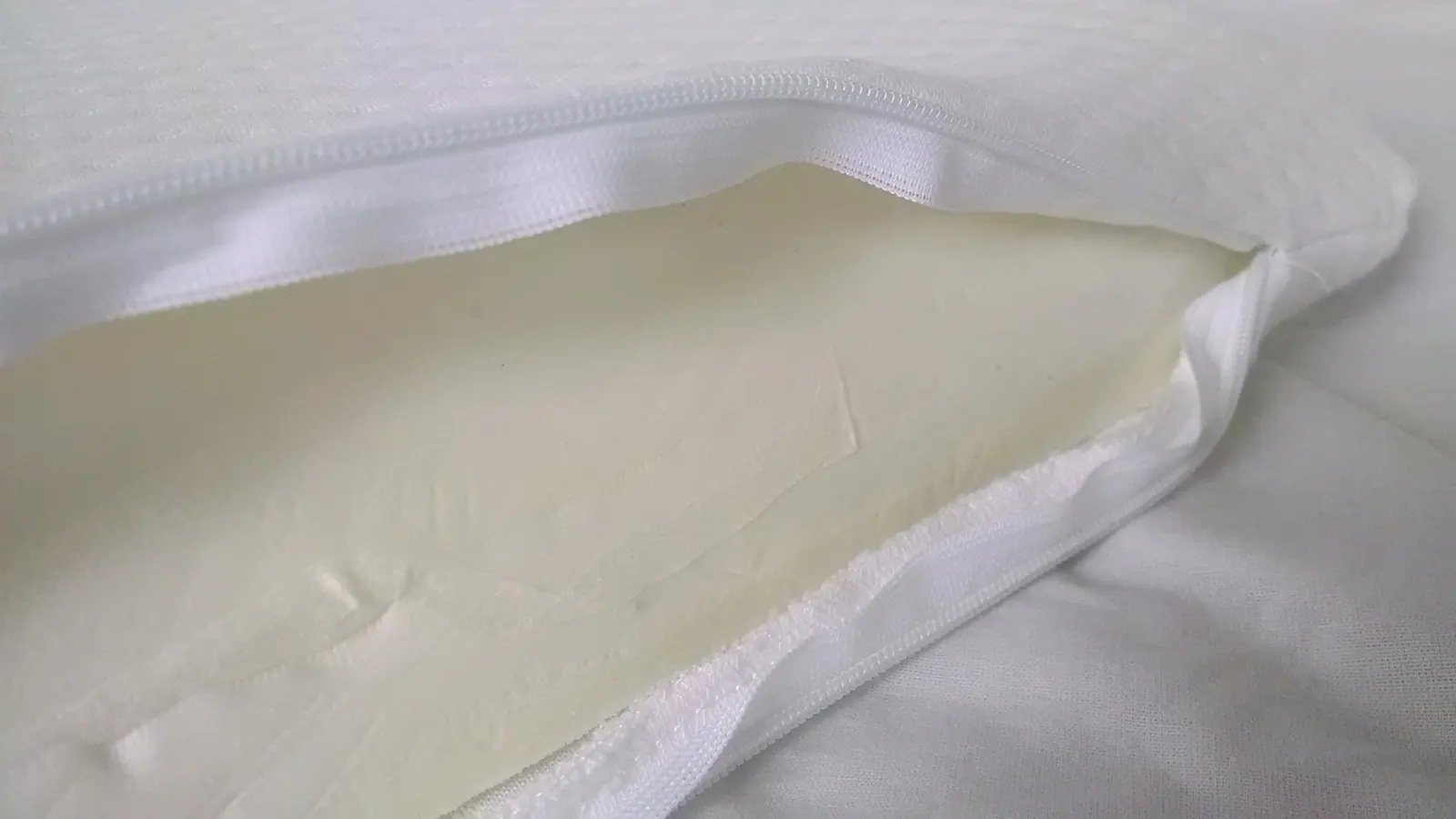
Is a hypoallergenic memory foam pillow good for allergies? A hypoallergenic memory foam pillow is a polyurethane foam pillow, usually with a zip-off cover, sold as better for allergy sufferers. Foam doesn’t keep dust mites out, and it can’t go in the washing machine, so the cover is what counts: a removable cover you can wash hot, over a mite-proof encasing. New foam also gives off VOCs, so air it out first.
Foam isn’t mite-proof. Memory foam is often sold as resistant to dust mites because it’s dense. But mites live on the skin flakes that collect on any pillow surface. In a year-long study, Rains and colleagues found new synthetic pillows built up about three times more mite allergen than feather pillows on the same beds. That study tested synthetic fiber pillows, not memory foam specifically, but it shows a synthetic material alone doesn’t make a pillow mite-free.
Since you can’t wash solid foam hot, set it up like this:
- Zip it into a dust mite pillow cover with a tight weave.
- Keep the pillow’s own cover on top and wash it as its care label allows, hot if possible.
- Add a pillowcase and wash it weekly; see hypoallergenic pillowcase.
Is memory foam toxic? The new-foam smell
That smell from a new memory foam pillow comes from volatile organic compounds (VOCs). Research on mattresses gives an idea of what happens:
- Boor and colleagues found all 20 crib mattresses they tested emitted VOCs, more when new and more at body temperature, with polyurethane foam releasing a wider range than polyester.
- Oz and colleagues confirmed body heat is the main driver of VOC emissions from polyurethane mattresses.
These studies tested mattresses, not pillows, and estimated exposure rather than symptoms. The EPA lists furnishings among indoor VOC sources and recommends ventilation, so unwrap a new pillow in an airy room and let it air out before sleeping on it.
Flame retardants in mattresses and foam pillows
Polyurethane foam has often been treated with flame retardants. The NIEHS notes they’ve been added to foam since the 1970s, that many persist in the environment and the body for years, and that some may be hazardous.
- Stapleton and colleagues found the flame retardant TDCPP in 15 of 26 foam samples from furniture, mattress pads and pillows bought mostly between 2003 and 2009.
- Cooper and colleagues screened 1,141 foam samples, including pillows, sent in by the public from 2014 to 2016: 52% contained a flame retardant above 1%, although use in furniture had declined.
The federal open-flame standard for mattresses (16 CFR 1633) explicitly excludes pillows, so a foam pillow isn’t covered by that rule. If you want to avoid added flame retardants, ask the seller directly.
Memory foam pillow for snoring
Memory foam is chosen mainly for support. In a small preliminary trial, Stavrou and colleagues found a memory foam pillow cut snoring events by about 47% over 3 hours in 32 people with sleep apnea. It didn’t look at allergy.
How to choose a hypoallergenic memory foam pillow
- Removable, washable cover, ideally hot-washable.
- Fits inside a mite-proof encasing.
- Ask about flame retardants and choose a seller who states none were added.
- Air out new foam before use.
- Compare fills in hypoallergenic pillows, or see latex pillow if you prefer latex (not for latex allergy).
Sources & further reading
- Clinical and Experimental Allergy — Rains and colleagues, 1999: new synthetic pillows built up about three times more mite allergen than feather pillows over 12 months on the same beds. DOI: 10.1046/j.1365-2222.1999.00470.x.
- Environmental Science & Technology — Boor and colleagues, 2014: all 20 crib mattresses tested emitted VOCs, more at body temperature and when new; polyurethane foam released a wider range than polyester. DOI: 10.1021/es405625q.
- Environmental Science & Technology — Oz and colleagues, 2019: VOC emissions from 8 polyurethane mattresses rose under sleeping conditions, driven mainly by body heat. DOI: 10.1021/acs.est.9b01557.
- U.S. Environmental Protection Agency — many VOCs are up to ten times higher indoors than outdoors, furnishings are among the sources, and ventilation helps.
- Environmental Science & Technology — Stapleton and colleagues, 2009: 15 of 26 polyurethane foam samples from furniture, mattress pads and pillows contained the flame retardant TDCPP at 1% to 5% by weight. DOI: 10.1021/es9014019.
- Environmental Science & Technology — Cooper and colleagues, 2016: 52% of 1,141 foam samples from US products, including pillows, contained a flame retardant above 1%, with use in furniture declining in recent years. DOI: 10.1021/acs.est.6b01602.
- National Institute of Environmental Health Sciences (NIH) — flame retardants have been added to foam since the 1970s; many persist in the environment and body for years, and some may be hazardous.
- U.S. Consumer Product Safety Commission (16 CFR 1633) — 2025: the federal open-flame standard for mattresses explicitly excludes pillows, mattress pads and toppers.
- Frontiers in Medicine — Stavrou and colleagues, 2022: small preliminary trial in 32 people with sleep apnea in which a memory foam pillow cut snoring events by about 47% over 3 hours. DOI: 10.3389/fmed.2022.842224.
More in Bedding
Dust Mite Mattress Cover: What to Look For in Encasements
A dust mite mattress cover is the core of bedroom mite control. What pore size, zippers and breathability mean, and what studies say covers can do.
Hypoallergenic Pillows: What the Fill Really Changes
Hypoallergenic pillows usually just have a synthetic fill. What fill changes for dust mite and feather allergies, and the washing habits that matter.

How to Get Rid of Dust Mites in Bed: A Washing Checklist
How to get rid of dust mites in bed: the water temperature that kills them, how often to wash, and the bedroom changes that cut mite allergen.

Hypoallergenic Mattress: What Actually Lowers Dust Mites
Hypoallergenic mattress guide: why mattresses hold the most dust mite allergen, research on surface fabric, age and humidity, and what really helps.

How Often Should You Wash Your Sheets? Weekly, and Hot
How often should you wash your sheets? Once a week, hot if you have dust mite allergy. What studies show about mites, skin germs and wash temperature.
Hypoallergenic Comforter: Shell, Washing and Fill Facts
A hypoallergenic comforter is one you can wash hot and often. What studies show on feather vs synthetic fill, tight shells and allergen-proof covers.