Nickel-Free Earrings: What the Label Really Promises
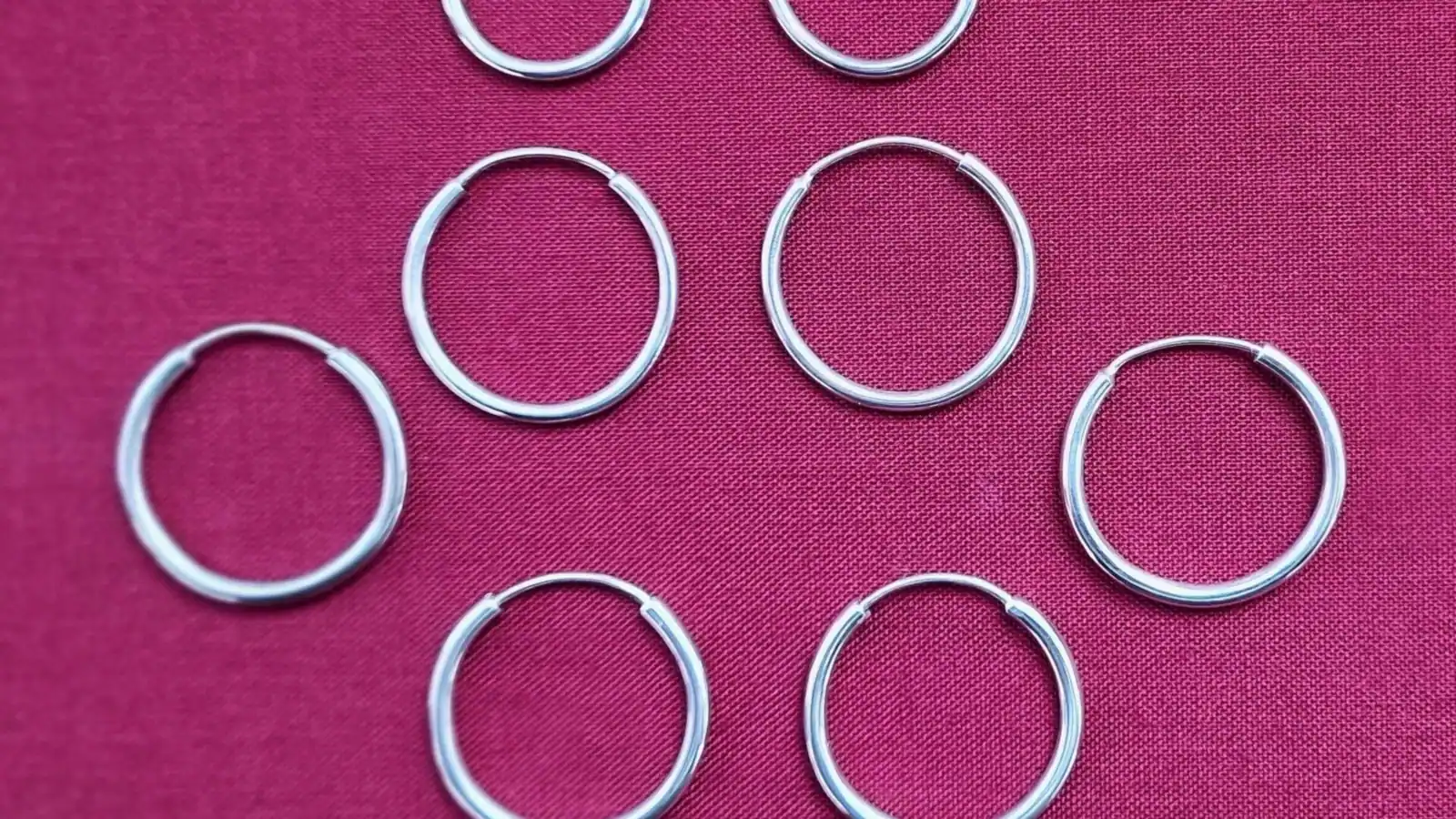

Are nickel-free earrings really free of nickel? Not necessarily. In the United States, nickel-free earrings is a label without a nickel-release limit comparable to the EU’s behind it. In the European Union, the rules limit how much nickel an earring releases onto skin rather than requiring zero nickel. For a nickel allergy, what counts is the metal the post is made of and whether anyone has tested its release.
What does nickel free mean? The EU rules
The EU has regulated nickel in jewelry since the 1990s, and its rules are the closest thing to a definition. The original 1994 Nickel Directive allowed posts for healing piercings only if they were homogeneous and contained under 0.05% nickel by mass. That content rule was later replaced by a release limit.
Today, REACH Annex XVII entry 27 sets the rules:
| Part of the earring | EU nickel release limit |
|---|---|
| Post inserted into a pierced ear | Less than 0.2 µg/cm²/week |
| Other parts in direct, prolonged skin contact | No more than 0.5 µg/cm²/week |
| Coated parts | Must stay at or below 0.5 µg/cm²/week for at least two years of normal use |
So an EU-compliant earring can contain some nickel as long as very little comes out. People who are very sensitive can still react near those limits, which is why some prefer metals that aren’t nickel alloys, such as titanium; see titanium earrings.
Are nickel free earrings hypoallergenic? Labels vs reality
Even with rules, a share of earrings fail. In Denmark, Wennervaldt and colleagues found 45 of 304 earrings (14.8%) released more nickel than the EU allows. In German state surveillance, Uter and Wolter found 16.2% of 160 piercing posts above the pass threshold in 2014, with no improvement since 2008.
The U.S. picture is murkier because, as Warshaw and colleagues note, North America has no nickel release rule comparable to the EU’s. When Hamann and colleagues put 96 U.S.-bought jewelry items in artificial sweat, 79 released nickel, at amounts from 0.01 up to 98 µg/cm²/week.
Price isn’t a guide, but where you buy is. In San Francisco, Thyssen and Maibach spot tested 277 inexpensive earrings. Positives came from 69% of samples from local artists, 42.9% from tourist stores, 24.1% from chains aimed at young women and 1.7% from chains aimed at mature women, and price didn’t predict the result. A study by Thyssen and colleagues of inexpensive earrings bought in London and Warsaw found 15.1% and 18.4% positive, mostly from street markets and independent shops rather than chains.
Why a nickel test kit can fool you
Many sellers and shoppers use the dimethylglyoxime (DMG) spot test, a swab that turns pink when it detects nickel. It’s useful, but it misses a lot:
- In the Danish study, DMG caught only 45.2% of earrings above the 0.2 piercing limit and 61.1% of those above 0.5.
- In earrings from Chinese and Thai markets, Hamann and colleagues found that 11.5% of DMG-negative earrings still had nickel as a major component and 26.9% as a minor one.
- Kanerva and colleagues found 3 of 10 metal samples were DMG negative even though they released considerable nickel, and warned that such metals shouldn’t be advertised as nickel-safe.
A pink result means avoid the earring. A negative result doesn’t prove it’s safe for a piercing. Our guide to the nickel allergy test explains both the swab and the patch test a dermatologist uses.
How to check before you buy nickel-free earrings
- Ask what the post is made of, by name: solid titanium, niobium, platinum, a stated gold karat or a stated steel grade.
- Ask whether it’s plated. A plated post is only as nickel-free as the metal underneath once the coating wears.
- Look for a checkable claim, such as compliance with the EU limits, rather than the word “nickel-free” alone.
- Check the back too. See hypoallergenic earring backs.
Related guides
If your ears react to almost everything, start with earrings for sensitive ears. Metal by metal, see titanium earrings, niobium earrings and surgical steel earrings. Nickel-free hoop earrings are covered in hypoallergenic hoop earrings, and the full range is in hypoallergenic earrings.
More in Jewelry
Hypoallergenic Earrings: Metals That Avoid Nickel
Hypoallergenic earrings explained: which metals avoid nickel, how to read the label, and what to ask a seller before you buy a pair for sensitive ears.
Titanium vs Surgical Steel: Which Suits Sensitive Skin?
Titanium vs surgical steel for nickel allergy: grades, nickel content, ASTM implant specifications, cost, and when each metal makes sense for your skin.
Is Sterling Silver Hypoallergenic? What Nickel Allergy Means
Is sterling silver hypoallergenic? Usually low in nickel, but plating, cheap alloys and tarnish complicate it. When silver suits sensitive skin.
Is 14k Gold Hypoallergenic? Karats, Alloys and Nickel
Is 14k gold hypoallergenic? Pure gold rarely causes reactions, but its alloy metals can. How karat, white or rose color and plating change nickel risk.
Sources & further reading
- European Union (EUR-Lex) — 2026: REACH Annex XVII entry 27: piercing posts must release less than 0.2 µg/cm²/week of nickel, earrings in prolonged skin contact no more than 0.5, and coatings must keep release at or below 0.5 for two years.
- European Union (EUR-Lex) — 1994: the original EU Nickel Directive allowed healing-piercing posts only if homogeneous and under 0.05% nickel by mass, a content rule later replaced by a release limit.
- Journal of the American Academy of Dermatology — Thyssen and Maibach, 2008: of 277 inexpensive San Francisco earrings, DMG positives ranged from 69% (local artists) to 1.7% (chains for mature women), and price didn't predict the result. DOI: 10.1016/j.jaad.2008.03.017.
- Contact Dermatitis — Hamann and colleagues, 2015: nickel was the fourth most common element in 956 jewelry parts, and 79 of 96 U.S.-bought items released nickel in artificial sweat. DOI: 10.1111/cod.12434.
- Contact Dermatitis — Wennervaldt and colleagues, 2021: 14.8% of 304 Danish earrings broke EU nickel limits; the DMG spot test caught only 45.2% of those above the piercing limit. DOI: 10.1111/cod.13832.
- Contact Dermatitis — Uter and Wolter, 2017: german surveillance in 2014 found 16.2% of 160 piercing posts above the nickel pass threshold, with no improvement since 2008. DOI: 10.1111/cod.12941.
- Journal of the European Academy of Dermatology and Venereology — Thyssen and colleagues, 2010: 15.1% of London and 18.4% of Warsaw inexpensive earrings were DMG positive, mainly from street markets and independent shops. DOI: 10.1111/j.1468-3083.2010.03909.x.
- Contact Dermatitis — Hamann and colleagues, 2010: about 30% of 557 earrings from Chinese and Thai markets were DMG positive, and 11.5% of DMG-negative ones still had nickel as a major component. DOI: 10.1111/j.1600-0536.2010.01694.x.
- Contact Dermatitis — Kanerva and colleagues, 1994: 3 of 10 metal samples were DMG negative despite releasing considerable nickel; the authors warn such metals shouldn't be sold as nickel-safe. DOI: 10.1111/j.1600-0536.1994.tb02023.x.
- Journal of the American Academy of Dermatology — Warshaw and colleagues, 2019: 17.5% of 44,097 North American patients reacted to nickel; North America has no nickel release regulation comparable to the EU. DOI: 10.1016/j.jaad.2018.09.058.